13. Trinion Naval Gun Family
Back to this item in New Technology Catalog
What It Is
- Heavy baseline: 10"/65 Trinion-H for CAG, using one complete Gun IWM and one mated Magazine IWM.
- Lite baseline: 10"/45 Trinion-L for DDG, using one lighter-armored Gun IWM with shorter barrels and a reduced ready magazine.
- Configuration: triple-barrel turret, Aegis/SPY-6 fire-control integration, autoloaded palletized ammunition handling, and no routine manual round handling.
- Both variants retain three independent breeches, loader channels, and elevation paths on one 10-inch ammunition family.
- Transitional path: Mk 45 Mod 4 remains baseline until qualification gates are complete.
- Integration model: IWM insertion at refit, not hull redesign.
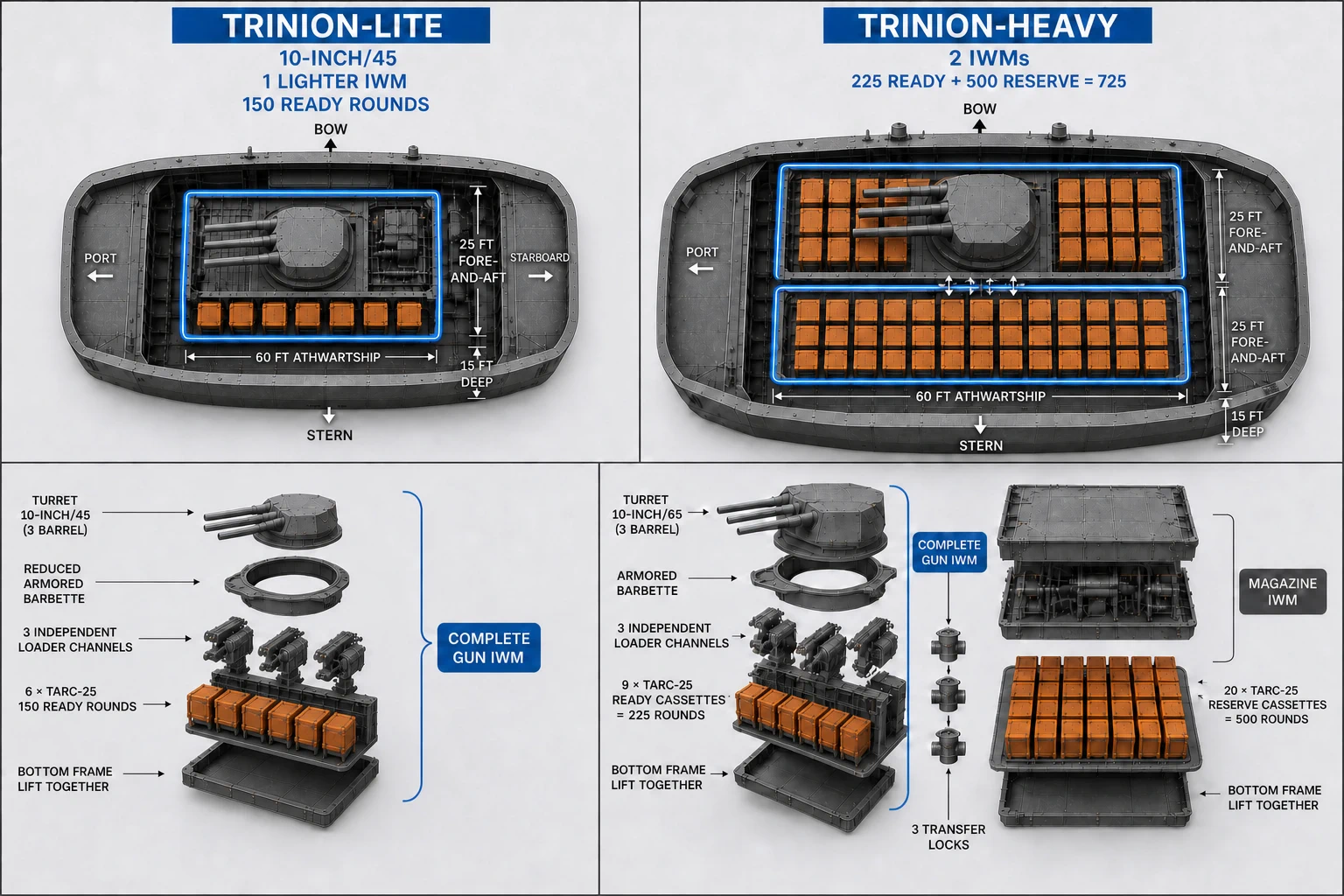
Variant packaging: Trinion-Lite fits in one IWM with 6 TARC-25 cassettes and 150 ready rounds. Trinion-Heavy uses a Gun IWM with 9 ready cassettes plus a separate Magazine IWM with 20 reserve cassettes, for 725 rounds total. The numeric baseline governs where the conceptual rendering shows repeated cassette forms.
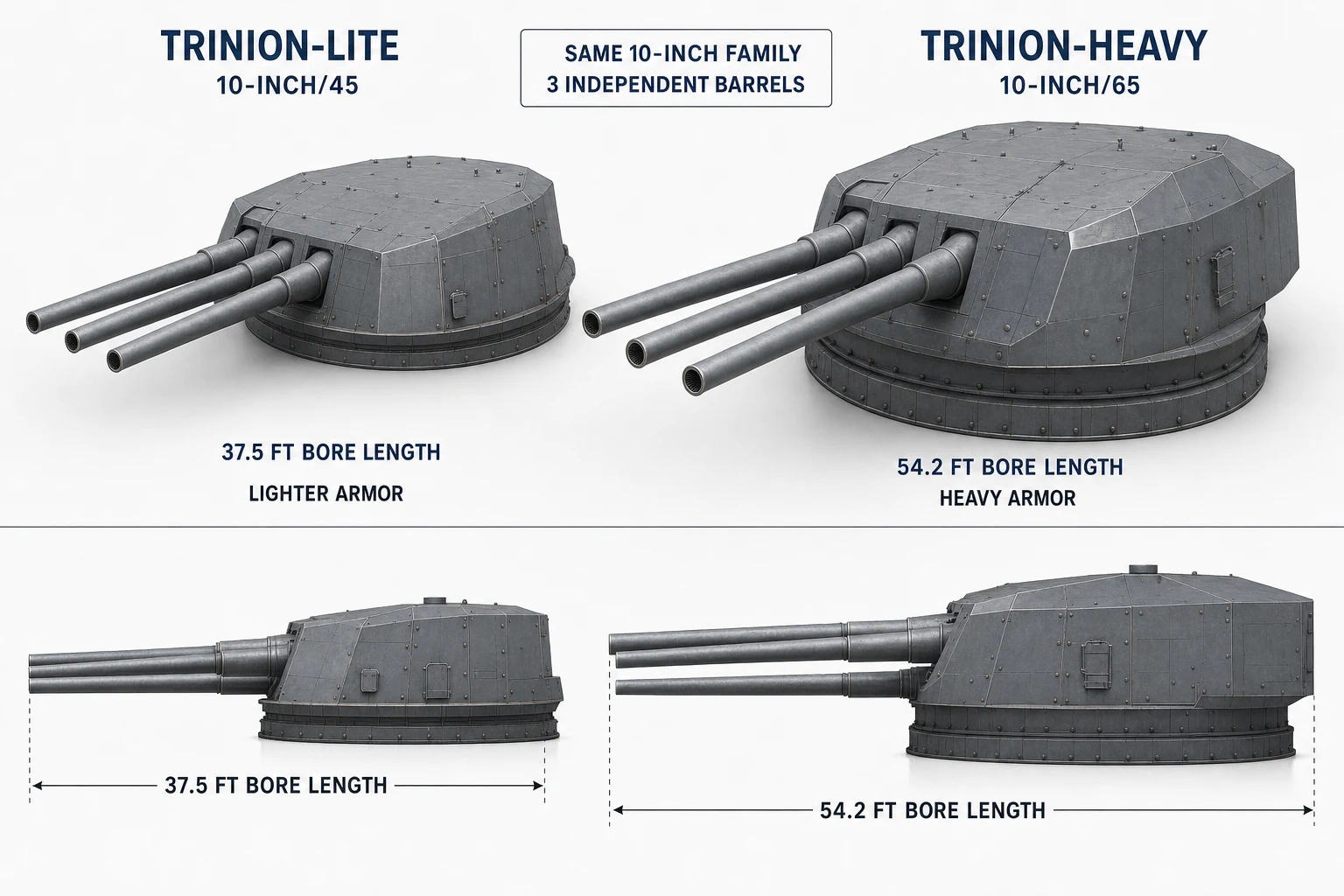
Turret-family scale: the 10"/45 Lite path uses a 37.5 ft bore and reduced armor for the DDG, while the 10"/65 Heavy path uses a 54.2 ft bore and heavier protection for the CAG. Both retain exactly three independently controlled barrels.
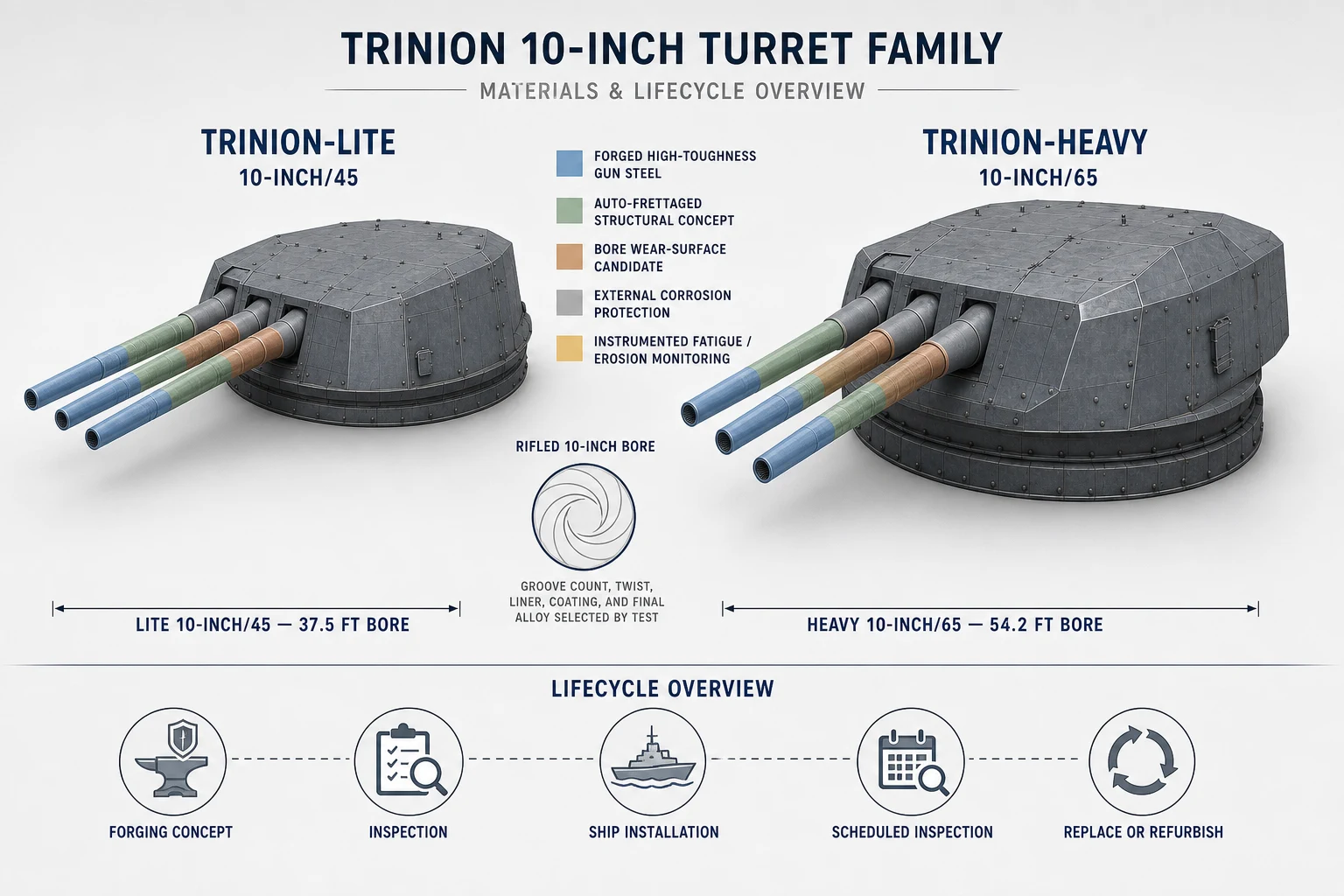
Materials and lifecycle concept: forged high-toughness gun steel, an autofrettaged structural approach, candidate bore wear protection, external corrosion protection, and instrumented fatigue and erosion monitoring define the research direction. Groove count, twist, liner, coating, and final alloy remain qualification-test decisions rather than locked specifications.
Why We Are Doing It
- Increase fleet naval-fire depth with a common gun family across classes.
- Protect CAG heavy-cruiser identity: without the 10-inch main battery, CAG collapses toward a standard CG role.
- Lower cost-per-engagement by using gun rounds where missile-class effects are unnecessary.
- Strengthen deterrence and crisis signaling with visible heavy-gun capability ("big stick" effect).
Used Today / What It Counters
- Used today: Mk 45 Mod 4 remains the active U.S. Navy baseline while Trinion is validated.
- Counters: surface and shore targets while reducing missile spend for missions that do not require missile-class weapons.
Current Stop Gap
- Mk 45 Mod 4 baseline remains in place until Trinion is fully certified.
Next Flight Implementation Steps
- Complete qualification gates for safety, reliability, and ammunition performance.
- Certify Trinion IWM fit within fleet-standard LCB and interface constraints.
- Insert by block/refit window (no mid-build redesign after first steel cut).
Options and Styles
- Gun Type Options: 10"/65 Trinion-H heavy two-IWM installation for CAG and 10"/45 Trinion-L single-IWM installation for DDG.
- Ammunition Family: Legacy-AP, Legacy-HE, 5-inch sabot projectile in a 10-inch sabot casing, flak anti-drone tungsten airburst, plus an under-development guided defensive-projectile research lane.
- Employment Styles: salvo fire, ripple fire, airburst/swarm intercept, and long-range surface/shore fires.
- Transitional Style: Mk 45 Mod 4 baseline remains active until Trinion qualification and fleet insertion gates are complete.
Mounting and Integration Particulars
- Primary insertion is through certified IWMs sized to fleet-standard 60 ft x 25 ft x 15 ft LCB constraints.
- Trinion-Lite fits completely inside one IWM: turret, reduced armored barbette, three loaders, controls, and 6 TARC-25 ready cassettes.
- Trinion-Heavy uses two consecutive crosswise IWMs on the centerline: one complete Gun IWM and one Magazine IWM connected through protected transfer locks.
- Upgrade flexibility: Trinion IWMs can be removed and replaced in refit windows with other certified IWM payloads (missile, DEW, railgun, or future systems) without hull redesign.
How It Works in Combat
- Sensor cueing originates from SPY-6, fire-control radar, EO/IR, and combat-system tracks; Trinion receives a fused fire solution through Aegis/CANES pathways.
- Trinion handles the high-volume, lower-cost fires lane while missile systems preserve inventory for targets requiring missile-class effects.
- Defensive fire research uses timed or programmable airburst loads against drones and may expand to selected airborne threats only after instrumented testing defines a certified engagement envelope.
- In CAG doctrine, Trinion is central to heavy-cruiser deterrence posture; CAG without 10-inch guns is treated as CG-equivalent rather than CAG-full capability.
Layered Engagement Model (Where Trinion Fits)
- Layer 1 | Long-range intercept/strike: outer-battle missile engagements from Mk 57 PVLS/APM and long-range missile inventory.
- Layer 2 | Mid-layer heavy gun fires: the Trinion 10-inch family engages surface, shore, and selected air/swarm lanes to reduce missile expenditure and keep pressure on mass threats.
- Layer 3 | Short-range missile defense: RAM/SeaRAM-class interceptors handle leakers and fast terminal threats inside missile-defense inner rings.
- Layer 4 | Terminal close-in defense: CIWS/Cerberus mounts and DEW effects provide the last protective layer against inbound drones, missiles, and fast attack craft.
- Layer logic: all four layers are managed in one fire-control picture; Trinion is the bridge between long-range missile combat and terminal close-in defense.
Cost and Program Position
- Trinion ammunition is positioned as a lower-cost fires lane than missiles for many repeated strike and defensive missions.
- Legacy-compatible round pathways preserve supply resilience while advanced rounds mature, and the program rule is that Trinion must be able to fire legacy U.S. Navy 10-inch naval rounds.
- Because ammunition and gun are one doctrine set, Trinion munitions are treated as part of Trinion new-tech maturation, not a detached program line.
- Sales framing: gun rounds are expected to be materially cheaper than missiles for repeat-fire missions, especially where legacy/NATO-compatible rounds can be used.
Ammunition Catalog (Trinion Package)
- Legacy-AP: legacy armor-piercing round family updated with modern powders, metallurgy, and projectile shaping to increase range and accuracy while preserving the 10-inch naval-gun baseline.
- Legacy-HE: legacy high-explosive round family modernized the same way for improved range, consistency, and impact efficiency.
- 5-inch sabot: a 5-inch projectile carried in a 10-inch sabot casing for extended-range, higher-velocity fire where reduced projectile size is acceptable.
- Flak anti-drone tungsten airburst: timed or proximity-burst defensive load designed to throw a dense tungsten cloud against drones, small unmanned craft, and swarm approaches.
- Guided projectiles (under development): future guided shell lane for higher-precision long-range fires once cost, survivability, and qualification justify insertion.
- Guided defensive projectile research: explores counter-UAS and selected airborne-target applications; it is not a validated anti-railgun or counter-hypersonic capability.
Capability boundary: Trinion does not claim assured interception of maneuvering hypersonic weapons or incoming railgun projectiles. Those threats are addressed through layered Navy interceptor integration, EW and deception, maneuver, offensive counterfire, and ship survivability unless future testing establishes a certified gun-defense role.
Program rule: the gun and this ammunition family are qualified, inserted, and modernized as one Trinion new-tech package, and the system must retain the ability to fire legacy U.S. Navy 10-inch naval rounds.