10. APM Hypersonic Launch System
Back to this item in New Technology Catalog
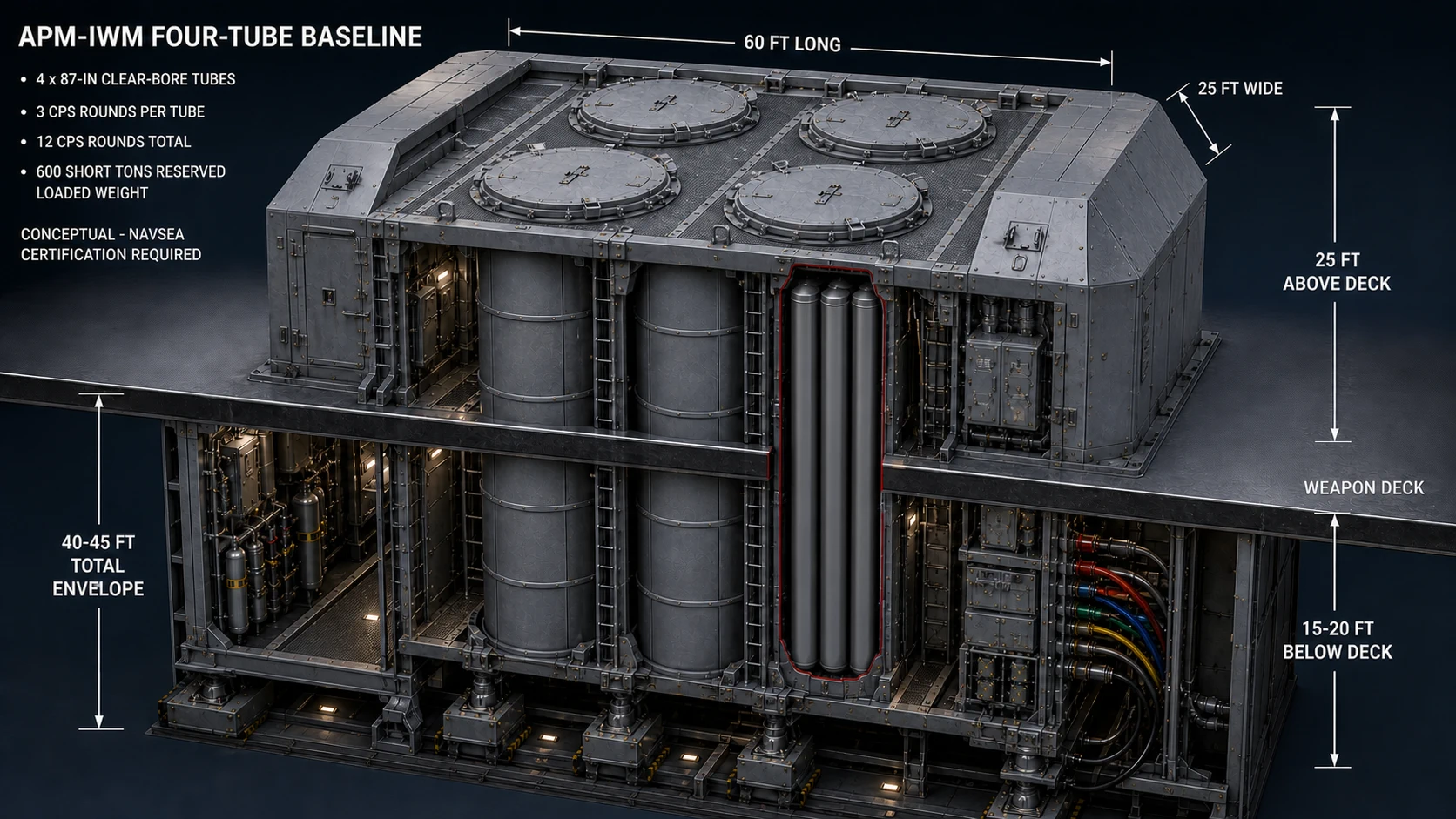
Locked APM-IWM visual baseline: four 87-inch clear-bore launch tubes in a 2-by-2 arrangement, with three sealed CPS all-up rounds per tube for 12 rounds total. The 60 ft x 25 ft module rises 25 ft above the weapon deck and extends 15-20 ft below it, reserving a 40-45 ft total integration envelope.
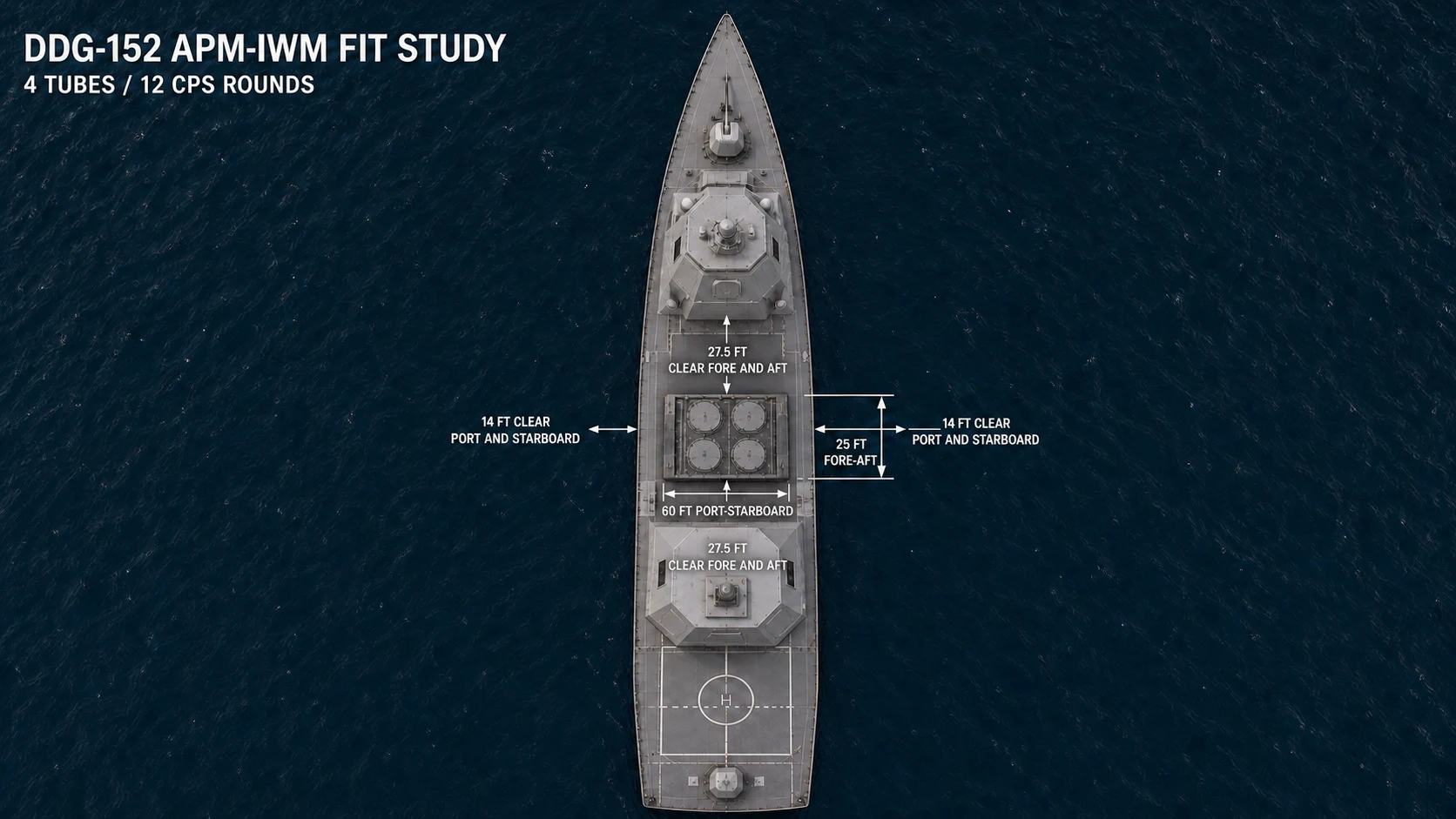
Crosswise DDG installation study: the 60 ft x 25 ft APM-IWM is rotated so 60 ft runs port-to-starboard and 25 ft runs fore-to-aft. Within the 88-ft beam and 80-ft missile-deck zone, one centered module leaves 14 ft gross clearance per side and 27.5 ft gross clearance fore and aft before structure, safety boundaries, and service routes are allocated.
What It Is
- Acronym meaning: APM = Advanced Payload Module.
- Locked IWM building block: four large-diameter launch tubes with three sealed CPS all-up rounds per tube, producing a 12-round module.
- Terminology rule: count four launch tubes and 12 rounds; do not describe the installation as 12 APM cells.
- Class use: one complete four-tube APM-IWM is selected as a whole module. CAG is the priority host, DDG is a weight- and mission-dependent option, and FFG remains an optional later integration path.
- Deployment alignment: the same CPS weapon family is being integrated through Zumwalt and Virginia modernization tracks, but TriSeadon requires a separately certified surface-ship installation.
- VLS continuity logic: TriSeadon primary VLS is Mk 57 PVLS; stop-gap compatibility is delivered by Mk 41 VLS tubes packaged in certified IWM modules.
- Role: long-range precision strike and strategic fires depth.
Locked Physical Envelope
| Item | Locked Planning Value | Control Note |
|---|---|---|
| Plan footprint | 60 ft x 25 ft | One LCB/IWM position; longitudinal or rotated crosswise as locked by class location |
| Raised deckhouse | 25 ft above weapon deck | Faceted armored enclosure with four hatches |
| Below-deck well | 15-20 ft below weapon deck | Shock foundations, services, access, and structural tie-in |
| Total envelope | 40-45 ft | Final depth follows Navy-certified APM interface data |
| Launcher arrangement | 4 x 87-inch clear-bore tubes, 2 by 2 | Three CPS all-up rounds per tube |
| Missile load | 12 CPS rounds | Approximately 120-125 short tons using open-source AUR-plus-canister estimates |
| Loaded-weight reservation | 600 short tons maximum design allowance | Reservation, not a published Navy launcher weight |
Weight discipline: the 600-short-ton value protects ship structure, stability, and growth margin for the complete loaded installation. Launcher steel, hatches, shock isolation, deckhouse structure, controls, services, and certification changes remain contractor/NAVSEA design-to-weight items inside that allowance.
Why We Are Doing It
- Add long-range strike depth and strategic fires capacity in a block-controlled pathway.
- Align with ongoing modernization tracks without breaking fleet commonality rules.
Used Today / What It Counters
- Used today: Mk 41 VLS legacy ecosystem is active now across U.S. surface combatants (including Flight III Burke); APM integration path is active on Zumwalt modernization.
- Current constraint: Mk 57 PVLS is the stronger/larger TriSeadon choice, but U.S. missile certification/production for Mk 57 PVLS slowed after Zumwalt truncation to three hulls.
- Counters: long-range strike gaps and insufficient deep-magazine strategic fires options.
Current Stop Gap
- Install Mk 41 VLS tubes as certified IWMs inside TriSeadon LCBs to preserve standard missile compatibility while Mk 57 PVLS missile support scales.
- TriSeadon APMs are also carried as IWMs, aligned to the same APM family being integrated on Zumwalt tracks.
Next Flight Implementation Steps
- Complete launcher/missile availability and integration readiness checks.
- Certify safety, fire-control integration, and loadout doctrine by class.
- Insert in next-flight block allocations (CAG/DDG priority, then FFG path).
Options and Styles
- Loadout Option: one locked four-tube IWM carries 12 CPS rounds; a host class either installs the complete certified module or selects another IWM.
- Compatibility Styles: Mk 57 PVLS primary architecture with Mk 41 VLS IWM stop-gap compatibility where required.
- Employment Styles: theater-depth strike, distributed fires, and mixed VLS/APM magazine planning.
Mounting and Integration Particulars
- Fielded as a semi-permanent, build- or major-refit-installed IWM with deep structural integration.
- Cold-gas launch behavior, blast boundaries, shock response, stability, magazine safety, hatch operation, access, exhaust, combat-system interfaces, and shipboard handling require Navy certification.
- Integrated with Mk 57 PVLS primary architecture and legacy compatibility logic during transition.
Published Basis and Status
- NAVSEA Virginia Payload Tube material identifies an 87-inch clear-bore large-diameter interface.
- Congressional Budget Office analysis describes 36 IRCPS missiles in 12 Zumwalt launch tubes, supporting the three-round-per-tube planning basis.
- HII modernization reporting confirms that Zumwalt's original gun installations were replaced by CPS missile tubes.
- Exact Navy APM exterior dimensions and installed launcher weight are not public; the TriSeadon dimensions and 600-short-ton allowance are controlled concept-design reservations pending certified data.
SLCM-N Reserved Integration Capability
Capability statement: TriSeadon reserves three launcher pathways for a future Navy-certified Nuclear-Armed Sea-Launched Cruise Missile (SLCM-N). This does not mean the missile is currently compatible with any one launcher. The Navy is still developing the SLCM-N missile, launcher, and canister, and public final interface data are not available.
| Reserved Path | TriSeadon Use | Certification Boundary |
|---|---|---|
| Mk 41 VLS Compatibility IWM | Preferred study path if the selected SLCM-N remains within a Tomahawk-scale strike-length canister envelope. | Mk 41 VLS launches Tomahawk today; that does not establish SLCM-N compatibility. A new canister, software, safety case, and launch qualification may be required. |
| Mk 57 PVLS IWM | Primary TriSeadon VLS path with greater physical growth margin. | Requires Navy certification of canister fit, launch dynamics, exhaust management, shock, hazards, combat-system control, and live-fire performance. |
| APM Large-Payload IWM | Largest physical reserve for a dedicated SLCM-N adapter or canister if ordinary VLS integration is not viable. | APM is optimized for CPS. SLCM-N use would be a separate certified payload and would trade away part of the ship's large-payload CPS capacity. |
Applies across the fleet: FFG, DDG, and CAG all retain access to these launcher architectures through their locked VLS and LCB/IWM positions. Actual fit remains class- and mission-dependent; it is not an automatic loadout.
Nuclear mission boundary: physical launcher compatibility is only one part of the requirement. A deployed capability also requires nuclear command-and-control, use-control and surety, secure magazines and handling routes, trained and certified personnel, approved maintenance and weapons facilities, port and deployment policy, and authorization by the Navy, Department of Defense, and National Nuclear Security Administration.
Program rule: preserve all three interfaces now, select the launcher only after the Navy publishes the final SLCM-N envelope, and do not represent the capability as operational until the complete weapon-ship system is certified.