Pick a Class First
Open Program Timeline Open Build and Refit Chronology Open Yard and Build-Location Logic
Frigate
Guided Missile Frigate (FFG)
The Fleet's escort and primary Anti-Submarine Warfare (ASW) combatant: a true blue-water, quiet undersea hunter that can link with all TriSeadon combat ships' sensors, aircraft, and weapons to create an anti-submarine net across vast areas.
Open FFG Profile
Destroyer
Guided-Missile Destroyer (DDG)
The Fleet's larger multi-mission escort and primary Anti-Air Warfare (AAW) combatant, with built-in Drone Monitoring and Control (DMC) and multiple layered CIWS using missiles, guns, and energy weapons in combination to protect and project combat power across the TriSeadon fleet.
Open DDG Profile
Cruiser
Guided-Missile Heavy Cruiser (CAG)
The Fleet's command flagship and heavy surface-strike crisis-response platform. The Cruiser maintains naval superiority through large guns, deep missile magazines, and Directed Energy Weapons (DEW). Its USMC Quick Reaction Force (QRF) is supported by AH-1Z Vipers, UH-1Y Venoms, MH-60s, Swift boats, and amphibious assault vehicles, with medevac capability and a forward fleet trauma center.
Open CAG Profile
Blue-Water Class Mission Profiles
Build-now, grow-through-life requirement: each class can begin with mature weapons, sensors, machinery, aviation, and combat-system baselines available to U.S. shipbuilders today. The larger hull envelopes are deliberate: protected space, weight, stability, power, cooling, data, access, and module margins allow later technology to be certified and installed without forcing the Navy to replace or structurally reconstruct the hull.
Design rule: commonality applies to standards, interfaces, selected machinery, combat-system foundations, training, and sustainment. It does not force one hull form or one mission load onto every class. The FFG is shaped and arranged for acoustic performance, the DDG for air-defense capacity and maneuver, and the CAG for stability, command depth, aviation, and sustained surface and shore fires.
TriSeadon is sized for the United States Navy's global mission, not for comparison with regional green-water fleets. Each class must cross oceans, remain on station, fight through damage, support manned and unmanned aviation, defeat drone and missile swarms, and reserve enough space, weight, electrical power, cooling, and data capacity for weapons and sensors that do not yet exist. The ships are larger because their missions require more endurance, magazine depth, aviation, unmanned reach, layered defense, and future growth.
FFG-64 | 500 ft x 66 ft x 17 ft | About 10,000 tons
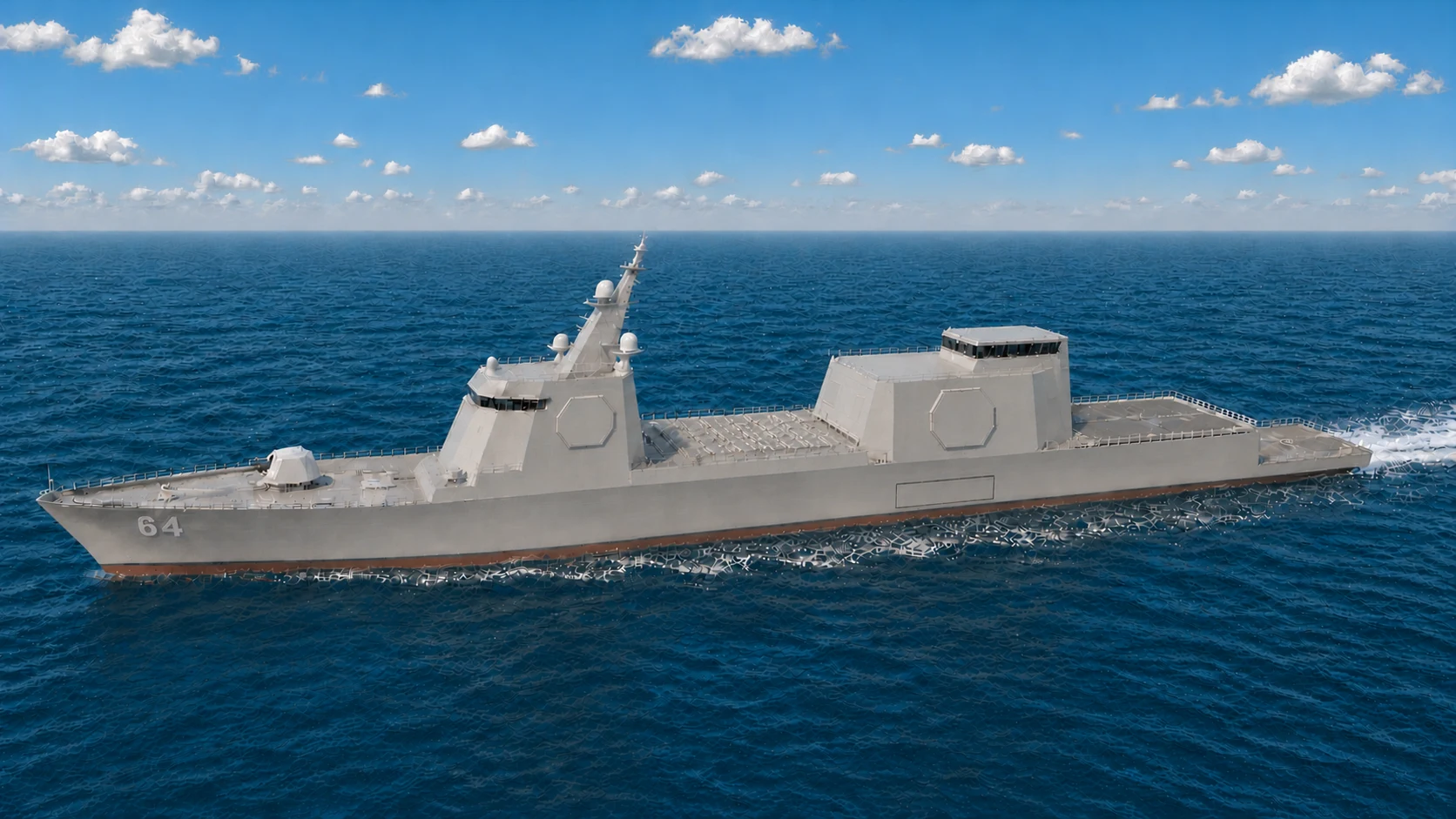
Current FFG-64 visual baseline: 50-ft forward superstructure, 40-ft Aegis-family aviation superstructure, and aft-aligned ATC above.
Mission and Role
Guided-Missile Frigate: the fleet's quiet, persistent ASW specialist and most numerous blue-water escort. The FFG is built around the SQQ-90 undersea-warfare system, dual-helicopter operations, distributed unmanned sensing, long endurance, and serious self-defense. Littoral control remains an available mission fit, not the reason for the ship's size or its defining role.
Key Dimensions and Performance
- Length 500 ft, beam 66 ft, draft 17 ft, displacement about 10,000 tons.
- Pod-fit draft caution: 17 ft remains the hull-design draft target, not a certified overall navigational draft with the enlarged Odyssey units. If 17 ft is imposed as an absolute appendage-inclusive limit, the known 23-25MW commercial pod envelope does not fit; final stern recess, propulsor, keel/skeg, and under-keel geometry must establish the actual navigational draft.
- Growth envelope: 12,000 tons is the conditional 20 percent naval-architecture limit, not 2,000 tons of spare payload. Any growth must preserve draft, freeboard, stability, structure, seakeeping, acoustic performance, propulsion margin, speed, and endurance.
- Vertical geometry: 50-ft forward superstructure including the bridge; 40-ft aft aviation superstructure comprising a 25-ft clear hangar and one 15-ft air-ready and briefing level. The reduced-footprint ATC sits above with its aft face flush to the aft bulkhead and is not included in the 40-ft height.
- Crew: 220-260 full fighting complement, above stripped automation minimums so the ship can stand proper watches and maintain its ASW, aviation, engineering, and combat-system load.
- Berthing capacity: 280, preserving margin for mission riders, temporary detachments, trainees, and ASW surge support.
- Blue-water endurance: 10,000 nm planning range and 30+ day independent-operation baseline.
- Propulsion set: two common Odyssey pods rated at 25MW continuous and 27MW short-duration objective each, two 35MW LM2500+G4 gas-turbine generators, four 8MW Fairbanks Morse Defense PA6B STC diesel-generator packages, and four 10MW peak PRIME battery modules.
- Speed profile: 28 kts sustained at 80 percent of pod continuous rating is the minimum design point; the current powering estimate is about 30 kts at full continuous pod output and about 31 kts at the short-duration objective rating. Final speed requires resistance, propulsion, cavitation, and model-basin validation. Diesel-dominant operation remains about 18 kts, with short-duration low-speed battery operation for ASW quiet-mode work.
Deck-Zone and LCB Arrangement
- 500-ft zone plan: 110-ft forecastle, 70-ft forward superstructure and bridge, 80-ft midships missile deck, 70-ft aft superstructure and hangars, 100-ft flight deck, and 70-ft aft gun deck.
- Height and form lock: forward superstructure 50 ft including bridge; aft aviation superstructure 40 ft excluding the aft-aligned ATC above. The FFG aft block uses the same scaled Aegis-family faceting and flush radar-array treatment as DDG and CAG.
- Three permanent LCBs: one longitudinal centerline bay in the forecastle, one longitudinal centerline bay on the midships missile deck, and one longitudinal centerline stern slide-in bay.
- Orientation rule: all FFG LCBs retain the standard 60-ft fore-to-aft by 25-ft port-to-starboard orientation on the ship centerline.
Blue-Water ASW Hull Design
- Design purpose: a quiet conventional blue-water monohull optimized for acoustic performance, endurance, aviation, unmanned operations, survivability, and future combat-system growth.
- Bow: long bulbous bow below the waterline with a fine raked and flared entry above it for efficient wave penetration, reserve buoyancy, and reduced pitching and slamming.
- Mid-body: flared round-bilge form with sufficient volume for sonar, isolated machinery, aviation stores, fuel, UxV support, weapons, and damage-control depth.
- Underwater body: deep centerline keel, lower-hull flare toward the bilges and outer-keel regions, and outboard bilge keels arranged for smooth flow, low cavitation, roll damping, and stable sonar performance.
- Stern: conventional blue-water stern with spoon-shaped recessed sections that fair clean water into the port and starboard Odyssey pods while retaining an early-flight shaft-and-rudder fallback.
- ASW priority: machinery skids, electric operation, pod inflow, hull flow, and mission loading remain governed by acoustic discipline. The ship is large enough to sustain the mission, not enlarged to become a general-purpose mini-destroyer.
Energy and Propulsion Architecture
- Diesel generation: four common 8MW PA6B STC packages, arranged two per acoustically treated machinery room, support efficient cruise, station keeping, hotel loads, and long endurance.
- Gas-turbine generation: two LM2500+G4 GT-GEN skids provide sprint and high combat-power margin.
- PRIME: four common 10MW peak battery modules provide ride-through reserve, load smoothing, emergency power, and short tactical quiet windows.
- AEGIR: two separated and interconnected distribution sections, AEGIR-1 and AEGIR-2, provide redundant switchboards, routing, isolation, and cross-feed control.
- Odyssey: two common removable azimuthing pods, each rated at 25MW continuous with a 27MW short-duration objective, provide propulsion and low-speed maneuvering without conventional rudders in the certified end-state configuration.
- Single fuel: ship machinery and embarked fleet aircraft follow the common JP-5 logistics policy.
Sensors and Combat Systems
- AN/SQQ-90-centered ASW architecture with AN/SQS-60 and AN/SQS-61 hull arrays, AN/SQR-20 multifunction towed-array pathway, variable-depth and future off-board acoustic growth.
- AN/SPY-6(V)3-family air and surface search radar with Aegis Baseline 10 and an X-band SPY-6-family fire-control and terminal-tracking layer.
- AN/SLQ-32(V)6 SEWIP, 360-degree EO/IR and IRST coverage, Nulka, chaff, decoys, passive sensing, CEC, CANES, Link-16/22, and JADC2 pathways.
- DMC coordinates MH-60, sonobuoys, UAVs, USVs, UUVs, remote sensors, classification, localization, targeting, and shared fleet prosecution.
Weapons and Layered Defense
- 64-cell Mk 57 PVLS architecture with a certified Mk 41 VLS IWM stop-gap pathway while Mk 57 PVLS missile compatibility and production mature.
- APM strike-module pathway, forward Mk 45 Mod 4 gun baseline, Mk38 gun layer, Mk32 torpedo tubes, ASROC, and aviation-delivered torpedoes.
- Three Cerberus terminal-defense positions establish the proposal requirement for at least one gun, one missile, and one energy close-in layer, with Phalanx, RAM or SeaRAM, HELIOS or dazzler-family options and future counter-UAS payloads subject to integration and certification.
- Six locked SCUTUM light-defense positions provide balanced port/starboard coverage for certified 30 mm, .50-caliber, MANPADS, and nonlethal force-protection adapters without consuming Cerberus foundations.
- Armor discipline, compartmentation, EW, decoys, chaff, unmanned pickets, and hard-kill systems work as one defense rather than as independent equipment lists.
Aviation, Boats, and Unmanned Systems
- 100 ft x 60 ft flight deck and two enclosed hangar bays, one for each of the 2 mission-configured MH-60R/S helicopters. UAV maintenance, payload preparation, compact storage, and launch-and-recovery equipment use shared aviation support spaces rather than a third full hangar.
- Hangar-door geometry: the aft hangar face remains vertical and planar through the complete door operating envelope, preserving unobstructed door travel, aircraft clearance, apron movement, and flight-deck access. Faceting begins only above or outboard of that protected envelope.
- ASW deployments normally favor two MH-60R helicopters so one aircraft can maintain contact while the second turns, rearms, refuels, or supports another prosecution axis.
- MQ-19 Aerosonde, MQ-27 ScanEagle, RQ-21 Blackjack-compatible and future VTOL UAV options extend ISR, communications relay, targeting, sonobuoy support, and counter-drone coverage.
- SeaFox, very-small UUV, small UUV or glider-family systems, and mission-selected USVs extend mine defense, route survey, passive sensing, distributed ASW, and off-axis classification.
- Two protected side boat garages support fleet-standard multipurpose RHIBs and mission-assigned boarding, EOD, recovery, or littoral teams.
Modules and Mission Fits
- Three longitudinal centerline LCB positions support the forecastle gun path, midships missile or mission-system path, and stern slide-in mission-loading path.
- Three ISO deck slots support rapid port-level changes for ISR, EW, counter-UAS, communications, UxV, mine-warfare, humanitarian, or other mission packages.
- IWM, IMM, ISO, LCB, Cerberus, and SCUTUM interfaces preserve common physical, electrical, cooling, data, exhaust, and certification pathways for future systems.
- Optional EOD, UDT, precision marksman, LEDET, VBSS, SOF-support, or humanitarian detachments embark by mission rather than redefining the permanent ASW crew.
Force-Multiplier Employment
- The FFG holds and refines the undersea picture while DDG and CAG sensors, MH-60s, sonobuoys, UxVs, missiles, ASROC, and torpedoes provide additional geometry and shooters.
- Its own radar, EW, missiles, gun, Cerberus layers, aircraft, and decoys allow blue-water independent operation without reducing the ship to a lightly defended sonar platform.
- The class remains interoperable with legacy fleet combatants while establishing the SQQ-90-centered TriSeadon ASW baseline.
Future Growth and Alternate Fits
- Priority growth areas are improved quieting, towed and variable-depth sonar, distributed UUV and USV operations, longer-duration battery quiet mode, stronger counter-UAS defense, and larger VTOL unmanned aircraft.
- DEW, missile, gun, EW, and sensor upgrades enter through common IWM, IMM, ISO, Cerberus, and scheduled-refit interfaces without reopening the hull design.
- Added capability must preserve the FFG's ASW-first acoustic, endurance, aviation, and maintenance requirements.
Open FFG crew, embarked-force, and aviation assignments Open platform systems drill-down Open fleet mission doctrine Alternate hull configurations
DDG-152 | 650 ft x 88 ft x 24 ft | About 15,000 tons
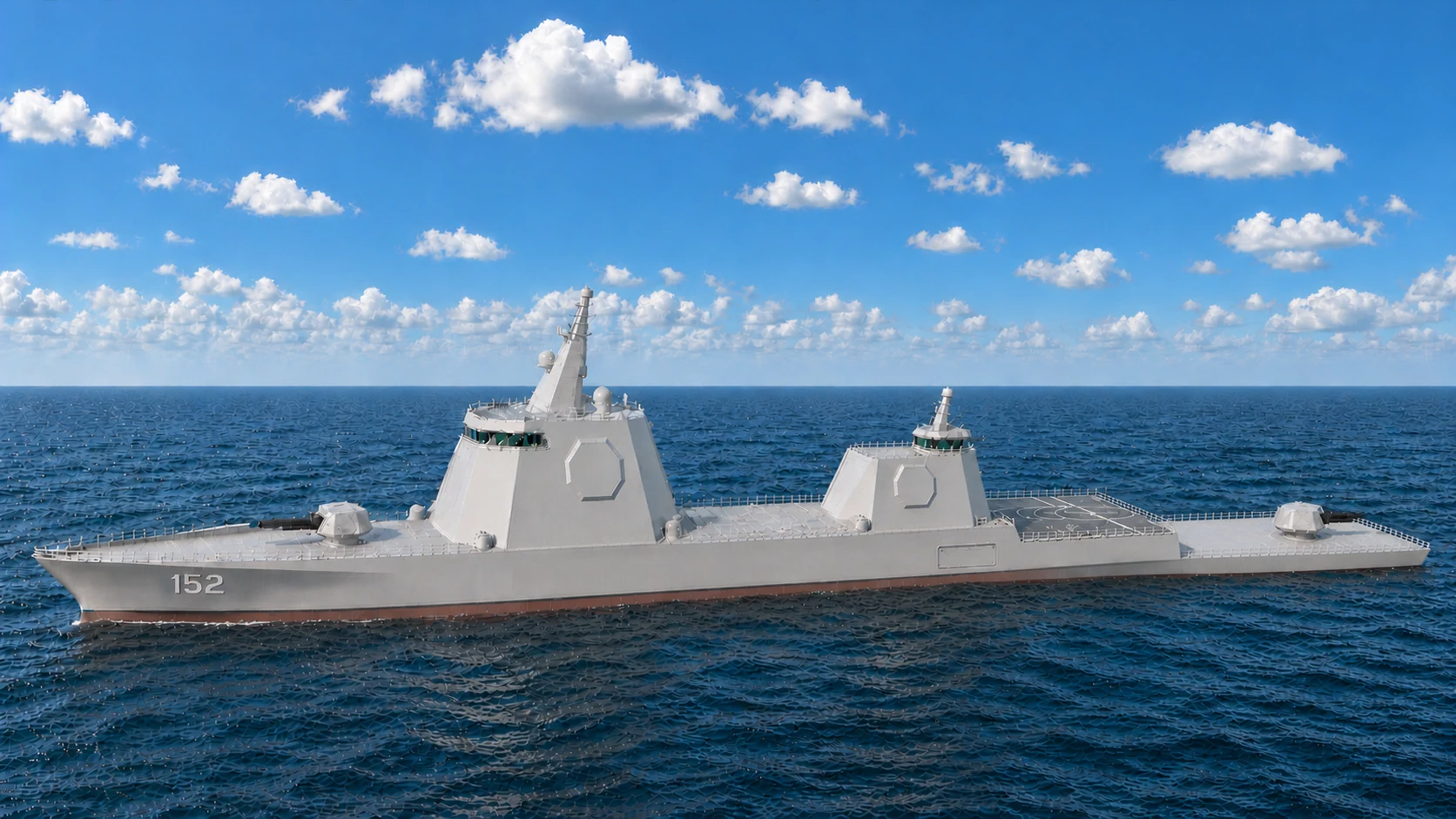
Current DDG-152 visual baseline: 65-ft forward superstructure, 40-ft Aegis-family aviation superstructure, and aft-aligned ATC above.
Mission and Role
Guided-Missile Destroyer: the task group's primary air, missile, and anti-drone defense combatant. The DDG is built around SPY-6, Aegis, Mk 57 PVLS, fleet fire control, maneuverability, layered terminal defense, and coordinated sensor-to-shooter operations.
Key Dimensions and Performance
- Length 650 ft, beam 88 ft, draft 24 ft, displacement about 15,000 tons.
- Pod-fit draft caution: 24 ft remains the hull-design draft target. Overall navigational draft with the enlarged Odyssey pods is not locked until the stern recess, propulsor, keel/skeg, and under-keel geometry are completed.
- Growth envelope: 18,000 tons is the conditional 20 percent naval-architecture limit, not 3,000 tons of spare payload. Any growth must preserve draft, freeboard, stability, structure, propulsion margin, speed, maneuverability, and endurance.
- Vertical geometry: 65-ft forward superstructure including the bridge and one additional level over the FFG; 40-ft aft aviation superstructure comprising a 25-ft clear hangar and one 15-ft air-ready and briefing level. The reduced-footprint ATC sits above with its aft face flush to the aft bulkhead and is not included in the 40-ft height.
- Crew: 320-350 full fighting complement with berthing for 380, preserving proper watches, maintenance depth, aviation support, and mission-detachment margin.
- Blue-water endurance: 10,000 nm planning range and 45+ day persistence.
- Propulsion set: three common Odyssey pods rated at 25MW continuous and 27MW short-duration objective each, three 35MW LM2500+G4 GT-GEN skids, six 8MW PA6B STC diesel-generator packages, and four 10MW peak PRIME modules.
- Speed profile: the current powering estimate is about 31.5 kts at full continuous pod output and about 32.5 kts at the short-duration objective rating. Final speed requires resistance, propulsion, cavitation, and model-basin validation.
- Power distribution: two separated and interconnected AEGIR sections, designated AEGIR-1 and AEGIR-2.
- Combat scale: 128 Mk 57 PVLS cells, APM capacity, large radar apertures, battle-management spaces, damage tolerance, cooling, and sustained high-power margin.
Deck-Zone and LCB Arrangement
- 650-ft zone plan: 150-ft forecastle, 85-ft forward superstructure and bridge, 80-ft midships missile deck, 85-ft aft superstructure and hangars, 125-ft flight deck, and 125-ft aft gun deck.
- Height lock: forward superstructure 65 ft including bridge; aft aviation superstructure 40 ft excluding the aft-aligned ATC above it.
- Five permanent LCBs: one longitudinal centerline forecastle bay; two crosswise midships bays arranged fore and aft on the centerline; and two longitudinal stern slide-in bays arranged port and starboard.
- Midships orientation: each 60-ft x 25-ft LCB rotates 90 degrees so 60 ft runs port-to-starboard and 25 ft runs fore-to-aft. Two crosswise bays consume 50 ft of the 80-ft missile-deck length before structural separation and access allowances.
Maneuverable Blue-Water Hull
- Fine flared bow, efficient bulb, higher-power stern flow, reinforced centerline structure, and carefully sized bilge keels balance blue-water seakeeping with rapid tactical maneuver.
- Three independently controlled azimuthing pods provide vectorable thrust, low-speed control, rapid turning response, and propulsion redundancy.
- The hull reserves weight and stability margin for large radar arrays, missile loads, DEW, aviation, armor, and later combat-system growth without sacrificing damaged stability.
Power, Sensors, and Battle Management
- Tri-power generation combines diesel-dominant endurance, turbine sprint and combat power, and PRIME ride-through, peak support, and tactical quiet windows through the redundant AEGIR distribution architecture.
- AN/SPY-6-family primary radar, X-band SPY-6-family fire-control layer, Aegis Baseline 10, CEC, CANES, Link-16/22, JADC2, EO/IR, IRST, and SEWIP form the AAW command baseline.
- SQQ-90-family sonar and DMC-controlled MH-60, UAV, USV, and UUV assets allow the DDG to reinforce the FFG-led ASW picture while remaining AAW-first.
Weapons and Layered Defense
- 128-cell Mk 57 PVLS architecture, Mk 41 VLS IWM stop-gap compatibility, APM pathway, forward Mk 45 Mod 4 baseline, torpedo and ASROC pathways, and future Trinion-L, railgun, or advanced IWM options.
- Five Cerberus positions provide overlapping gun, missile, and energy close-in sectors backed by RAM or SeaRAM, Phalanx-family guns, HELIOS or dazzler systems, EW, chaff, Nulka, decoys, and counter-UAS modules.
- Ten locked SCUTUM light-defense positions create balanced local-defense sectors for certified 30 mm, .50-caliber, MANPADS, and nonlethal force-protection adapters.
- Future growth emphasizes BMD, Navy-certified counter-hypersonic interceptor integration, stronger DEW, later radar generations, potential railgun or heavy-gun fits, and denser unmanned control.
Aviation, Unmanned Systems, and Modules
- 125 ft x 80 ft flight deck and three enclosed hangar bays: one dedicated bay for each of the 2 mission-configured MH-60R/S helicopters and one dedicated UAV-support bay. Mission selection can emphasize SAR, ASW, utility, or a mixed detachment.
- Hangar-door geometry: the aft hangar face remains vertical and planar through the complete door operating envelope, preserving unobstructed door travel, aircraft clearance, apron movement, and flight-deck access. Faceting begins only above or outboard of that protected envelope.
- DMC coordinates UAV, USV, UUV, relay, targeting, counter-drone, SAR, and engagement-support operations.
- LCB, IWM, IMM, ISO, Cerberus, and SCUTUM interfaces permit mission and weapon changes through certified common connections rather than hull redesign.
Open DDG crew, embarked-force, and aviation assignments Open platform systems drill-down Open fleet mission doctrine Alternate hull configurations
CAG-3 | 800 ft x 108 ft x 30 ft | About 32,000 tons
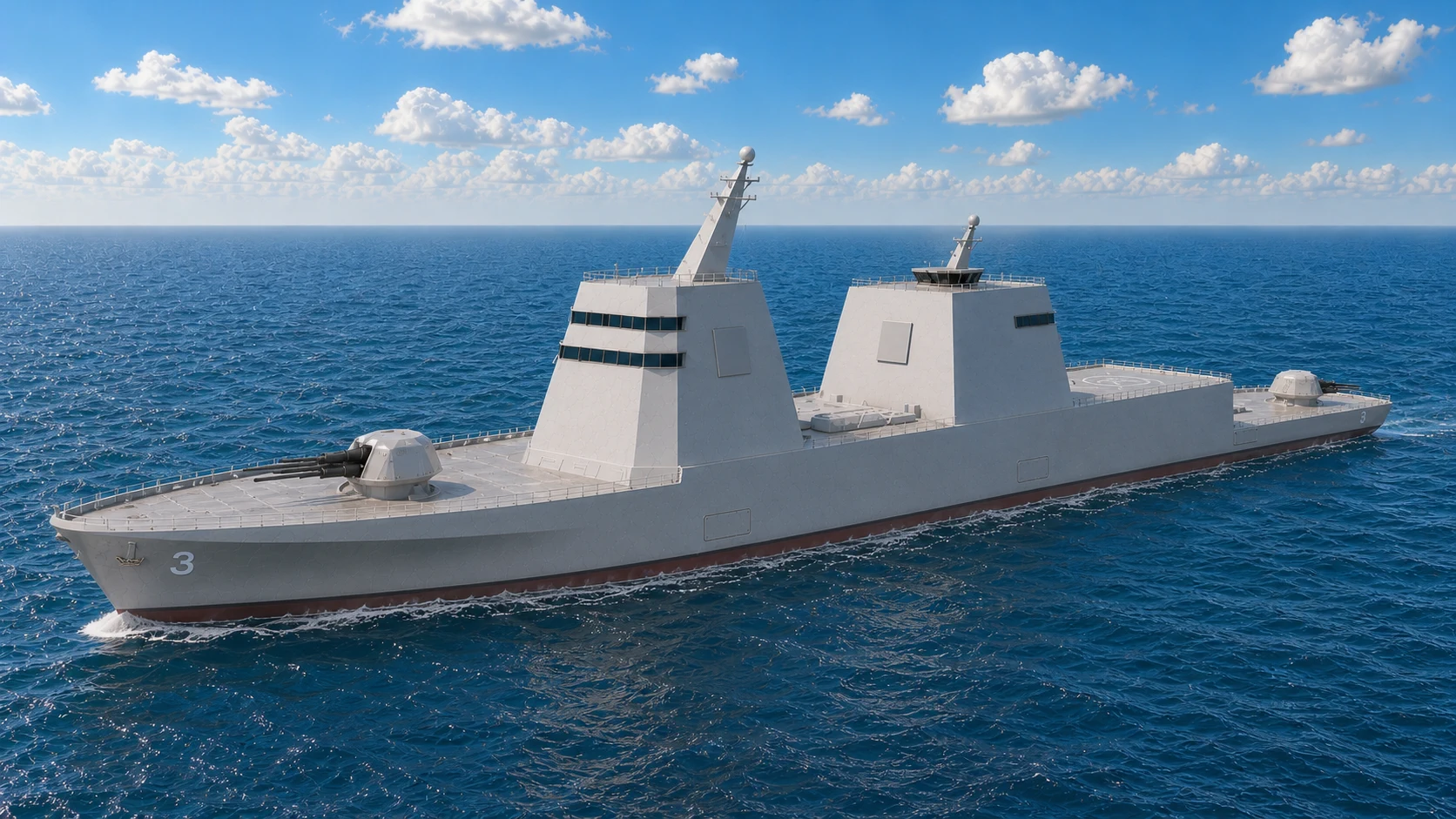
Current CAG-3 visual baseline: selected port-bow rendering with the two-level bridge treatment, square SPY-6 faces, aft-raked main mast, half-height aft mast, and separated flight and aft-gun decks.
Open measured 360-degree CAG-3 model
Mission and Role
Guided-Missile Heavy Cruiser: the fleet's stable command flagship and primary heavy surface-strike, naval-fires, aviation-support, QRF, and medical-support combatant.
Key Dimensions and Performance
- Length 800 ft, beam 108 ft, draft 30 ft, displacement about 32,000 tons.
- Pod-fit draft caution: 30 ft remains the hull-design draft target. Overall navigational draft with the enlarged Odyssey pods is not locked until the two propulsion zones, stern recesses, propulsors, keel/skeg protection, and under-keel geometry are completed.
- Growth envelope: 35,000 tons is an intermediate BBG-oriented objective study case inside the conditional 38,400-ton 20 percent limit. Neither figure is spare payload; added displacement requires complete stability, structure, draft, freeboard, seakeeping, propulsion, speed, and endurance validation.
- Vertical geometry: 80-ft forward superstructure including the bridge and flag bridge; 60-ft aft aviation superstructure comprising a 30-ft clear hangar and two 15-ft aviation-support levels. Level 03 supports aircrew ready, meeting, and briefing functions; level 04 houses Drone Monitoring and Control. The level-05 ATC is 40 ft wide, centered on the 80-ft-wide aft-superstructure roof, and aligned with the aft bulkhead. It is additional to the 60-ft height.
- Crew: 450-500 full fighting complement with berthing for 580, including flag staff, aviation, QRF, medical, diplomatic, trainee, and crisis-response margin.
- Blue-water endurance: 10,000 nm planning range and 60+ day independent-operation baseline.
- Propulsion set: four common Odyssey pods rated at 25MW continuous and 27MW short-duration objective each, four 35MW LM2500+G4 GT-GEN skids, eight 8MW PA6B STC diesel-generator packages, and six 10MW peak PRIME modules.
- Speed profile: the current powering estimate is about 29.5 kts at full continuous pod output and about 30 kts at the short-duration objective rating. Final speed requires resistance, propulsion, cavitation, and model-basin validation.
- Power distribution: three separated and interconnected AEGIR sections, designated AEGIR-1, AEGIR-2, and AEGIR-3.
- Combat scale: 200 Mk 57 PVLS cells, APM and Trinion growth, flagship command spaces, large magazines and stores, aviation depth, medical support, heavy subdivision, and the fleet's largest power and cooling reserve.
Deck-Zone and LCB Arrangement
- 800-ft zone plan: 220-ft forecastle, 100-ft forward superstructure and bridge, 80-ft midships missile deck, 100-ft aft superstructure and hangars, 150-ft flight deck, and 150-ft aft gun deck.
- Height lock: forward superstructure 80 ft including bridge and flag bridge; aft aviation superstructure 60 ft excluding the aft-aligned ATC above it.
- Aft deck relationship: the 150-ft flight deck is on 01 level, exactly 15 ft above the 150-ft aft gun deck on 00 main deck. The centerline aft Trinion remains forward on the gun deck, clear of the flight deck.
- Eight permanent LCBs: two crosswise forecastle bays, one crosswise midships bay, two crosswise aft-gun-deck bays, and three longitudinal stern slide-in bays arranged port, center, and starboard.
- Deck orientation: forecastle, midships, and aft-gun-deck LCBs rotate 90 degrees with their 60-ft axes port-to-starboard. Stern slide-ins remain longitudinal with aft-facing openings.
Stable Heavy-Cruiser Hull
- Long bulbous bow, fine flared entry, broad high-freeboard mid-body, deep subdivision, strong centerline structure, and substantial bilge-keel roll damping prioritize stability and seakeeping.
- Four recessed azimuthing pod positions receive clean flow while preserving aft buoyancy and steady flight-deck behavior.
- The broad waterplane and heavy damping bias support radar, major guns, missiles, aviation, command work, boats, and medical operations in higher sea states.
Power, Sensors, and Flagship Command
- Tri-power generation and redundant AEGIR distribution sustain propulsion, SPY-6-family radar, X-band fire control, EW, aviation, command systems, medical loads, DEW, and battle-damage recovery.
- Aegis Baseline 10, CEC, CANES, Link-16/22, JADC2, SQQ-90-family ASW, SEWIP, EO/IR, IRST, DMC, ATC, and flagship staff spaces coordinate the full task group.
- Dedicated flag, planning, briefing, communications, ready-room, admiral, and distinguished-visitor spaces support sustained fleet command and high-level crisis engagement.
Weapons and Layered Defense
- 200-cell Mk 57 PVLS architecture, Mk 41 VLS IWM stop-gap compatibility, APM strike capacity, forward and aft major-gun pathways, torpedo systems, and Trinion heavy-gun insertion through certified build or major-refit decisions.
- Eight Cerberus positions create the fleet's deepest gun, missile, and energy terminal-defense belt, reinforced by RAM or SeaRAM, Phalanx-family guns, HELIOS or dazzler systems, EW, Nulka, chaff, decoys, armor, and compartmentation.
- Sixteen locked SCUTUM light-defense positions distribute certified 30 mm, .50-caliber, MANPADS, and nonlethal force-protection options around the heavy cruiser's larger perimeter.
- Future growth includes Navy-certified counter-hypersonic interceptors, stronger DEW, potential railgun or advanced-gun modules, later radar generations, larger VTOL drones, and additional command systems.
Aviation, QRF, Boats, and Medical Center
- 150 ft x 100 ft flight deck and five enclosed hangar bays: one shared Viper bay, one shared Venom bay, and one dedicated bay for each of the 3 MH-60 helicopters. UAV maintenance and future-growth support are integrated into the aviation workshop and mission-support spaces.
- Hangar-door geometry: five separate doors, each 20 ft wide by 25 ft tall, occupy the vertical aft face of the 100-ft-wide, 30-ft-clear hangar. The planar operating envelope preserves simultaneous door travel, aircraft clearance, apron movement, and flight-deck access. Faceting begins only above or outboard of that protected envelope.
- DMC and ATC coordinate UAV, USV, UUV, loitering, relay, reconnaissance, counter-drone, ASW, assault, SAR, medevac, and recovery operations.
- The standing 32-Marine QRF uses aviation, RHIBs, the protected 16-meter-class Admiral's Launch, and mission-loaded IMM or ISO craft and vehicles for air, sea, land, or mixed insertion.
- The afloat medical center provides emergency and urgent care, trauma stabilization, surgery, imaging, ICU-level support, short recovery, diver treatment, and medevac coordination with an 18-20 person medical detachment.
Modules and Future Growth
- Eight LCB positions comprise five crosswise deck bays and three longitudinal stern slide-ins; eight separate ISO slots support command, strike, gun, missile, EW, UxV, QRF, humanitarian, counter-UAS, and other certified mission packages.
- IWM, IMM, ISO, LCB, Cerberus, and SCUTUM standards allow new weapons and missions to enter new construction or scheduled refits without redesigning the ship.
- The CAG carries the fleet's largest reserved electrical, cooling, weight, deck, magazine, workshop, and integration margin.
Open CAG crew, embarked-force, QRF, aviation, and medical assignments Open platform systems drill-down Open fleet mission doctrine Alternate hull configurations
Access by Need
I need class-level differencesStart with FFG, DDG, or CAG roles and profiles.
I need embarked capabilities and forcesAviation, flagship, QRF, medical-center, and mission-detachment assignments by class.
I need expedition or support hull conceptsSee where non-core hulls fit without breaking the baseline fleet.
I need build configuration optionsLCB and ISO/module decisions at construction time.
I need sensors/weapons/armor detailsPlatform systems and tech-stack drill-down path.
I need actual drawings and deck layoutsOpen the visual dossier for renderings, floorplans, and weapon-system sheets.
I need build dates and yard timingOpen the year-by-year production, lane, and refit schedule.
Embarked Capabilities and Forces
The embarked baseline is organized around four primary areas: Aviation, Flagship, QRF, and the CAG Afloat Medical Center. Class details then define supporting EOD, sniper, VBSS-style, ATC, boat, vehicle, and unmanned-system assignments.
Open Dedicated Detachments Page | Open Crew Assignments Page | Open Boat Launch and Recovery Plan
AviationCAG air-assault and QRF aviation, DDG SAR-first aviation, FFG persistent ASW aviation, ATC, flight decks, hangars, and maintenance depth.
FlagshipCAG command staff, secure planning and briefing spaces, fleet coordination, communications, and distinguished-visitor support.
QRFThe standing 32-Marine CAG response force, aviation and surface lift, plus DDG and FFG screening, access, and recovery support.
Afloat Medical CenterEmergency and urgent care, trauma stabilization, surgery, imaging, ICU-level support, short recovery, diagnostics, and medevac coordination.
CAG: flagship command, aviation, QRF, and medical depth
- Medical baseline: full afloat medical suite with about 25 beds, ER, operating room, trauma bay, surgical recovery, ICU, X-ray, CT, MRI, dental, lab, pharmacy, blood-storage, isolation or contamination-handling spaces, and diver or bends-treatment support.
- Afloat medical-center logic: this capability is far beyond a normal combatant sickbay. It is a combat medical center sized for emergency and urgent care, trauma stabilization, surgery, recovery, imaging, medevac coordination, diver support, and short-duration casualty holding while the ship stays operational.
- Medical detachment size: 18-20 personnel.
- QRF baseline: 32 embarked Marines as the standing quick-reaction package, with 2-4 mission-assigned precision-marksmanship personnel when required.
- ATC role: dedicated aviation traffic-control space cross-wired with Bridge, CIC, and DMC for assault launch, medevac, recovery, and mixed helo or UAV sequencing.
- ATC radar and landing-aid layer: the CAG carries the heaviest aviation-control package in the fleet, including dedicated close-range air-traffic radar support, approach and recovery radar logic, TACAN, IFF, deck-landing aids, and UAV traffic-management support for helicopters and drones operating simultaneously.
- Flight deck: 150 ft x 100 ft.
- Hangar baseline: five enclosed hangar bays store the complete manned detachment inside: one shared bay for 2 AH-1Z Vipers, one shared bay for 2 UH-1Y Venoms, and three individual MH-60 bays. Protected UAV maintenance, payload preparation, spares, launch-and-recovery equipment, and future-growth support are integrated into the aviation workshop and mission-support spaces.
- Aft hangar face: vertical and planar across the complete hangar-door operating envelope; no stealth slope, overhang, or side facet may obstruct a door, aircraft clearance, apron movement, or the flight-deck approach.
- Aviation growth and MV-22 limit: the expanded flight deck, hangars, and UAV handling deck reserve power, data, fueling, tie-down, maintenance, and control margin for future VTOL drones and larger unmanned aircraft. The CAG may be engineered to accept an MV-22 for a limited contingency landing, transfer, or casualty movement subject to certification, but the Osprey is not part of the embarked baseline and is not intended for routine basing, hangaring, maintenance, or sustained deck operations.
- Aviation baseline: 2 UH-1Y Venoms for QRF delivery and extraction; 2 AH-1Z Vipers for armed escort, cover, and fire support; 3 mission-configured MH-60R/S helicopters for command support, exfiltration, medevac, SAR, utility, and ASW; plus MQ-19 Aerosonde, MQ-27 ScanEagle, RQ-21 Blackjack-compatible, and other mission-selected UAV packages.
- Air detachment logic: unlike the FFG and DDG, the CAG carries separate but coordinated USMC and USN aviation detachments with greater maintenance depth, parts storage, and shop capacity for simultaneous Viper, Venom, and MH-60 operations.
- Task-group maintenance depth: as the flagship for a task group that can include SSNs, FFGs, and DDGs, the CAG supports its own aircraft and compatible helicopters temporarily received from accompanying surface ships. Its expanded shops, maintainers, parts inventory, and handling capacity provide the task group greater depth in scheduled maintenance, troubleshooting, avionics and ordnance work, rotor and engine changes, component replacement, repair, and aviation battle-damage recovery.
- Organic boat baseline: 2 fleet-standard 7-meter multipurpose RHIBs, one in each side boat garage, plus 1 protected CAG-only TriSeadon Admiral's Launch (TAL). TAL is a 16-meter-class derivative of the proven U.S. Navy RCB/Swedish CB90 family, modified for approximately 20 total occupants, a protected VIP interior, compact radar, EO/IR, passive EW and threat warning, secure CAG data links, chaff and decoys, protected navigation and communications, layered counter-drone measures, and an optional certified `.50-cal` station. Swift boats, additional assault craft, LEDET or drug-interdiction boats, and counter-piracy packages are mission-module additions rather than permanent organic boats.
- Undersea-vehicle baseline: SeaFox identification, training, and mine-neutralization vehicles; reusable very-small UUVs for confined-water reconnaissance and inspection; and small UUV or Seaglider-family systems for survey, ocean sensing, mine search, and distributed ASW support. CAG carries the deepest command, maintenance, charging, payload, and task-group coordination capacity.
- QRF mission flow: the CAG launches the quick-reaction force by air, sea, land, or mixed insertion. Venoms deliver and extract the main body, Vipers escort and cover the force, mission-configured MH-60s support command, exfiltration, medevac, SAR, utility, and ASW, small UAVs extend unmanned overwatch and communications relay, and organic RHIBs plus mission-assigned Swift boats or amphibious vehicles provide parallel sea-to-shore options.
- Fast boat arm: TAL serves as the protected mobile-command, extraction, medevac, and recovery node; organic RHIBs provide immediate utility and boarding capacity; Swift-Boat, Amphibious Assault Lift, Drug Interdiction/LEDET, Anti-Piracy/VBSS, and RHIB/SOF IMMs add mission craft and support; and CAG aviation plus UAV/USV/UUV coverage complete the layered package. Open the combined fast boat plan.
- Best-fit missions: embassy reinforcement, embassy evacuation, hostage recovery, contested-port entry, and SEAL or other small-team extraction.
- How the group works: the CAG provides command, lift, assault aviation, and trauma care; the DDG screens the lane with radar, missiles, counter-drone work, and precision fires; the FFG adds littoral scouting, UUV or USV route checks, EOD or UDT access work, and secondary boat-team support.
- Medical chain: casualties are stabilized and treated in the CAG's afloat medical center, then moved by MH-60 or follow-on transport to rear medical care when longer treatment is required.
- Mission detachment rule: NSW, SWCC, EOD, sniper, or LEDET elements can embark on the CAG when mission tasking requires them, but the default permanent package is the Marine QRF and aviation-assault support structure.
- Flagship baseline: embarked command-staff workspaces, secure planning and briefing rooms, expanded communications, distinguished-visitor support, and fleet-level coordination facilities.
- Role logic: the CAG carries flagship command, aviation, QRF, and medical depth in one integrated surface-combatant platform.
DDG: primary AAW shield, maritime operations detachment, and SAR-first aviation
- Medical baseline: standard destroyer sickbay and casualty-stabilization capability, sized for routine fleet operations, trauma treatment, and transfer to the CAG or shore medical support when needed.
- Detachment baseline: one mission-based maritime operations package built around VBSS, LEDET, SWCC, NSW support, or similar boarding-assault roles as tasking requires.
- Sniper baseline: 2-person sniper team is the planning baseline when the mission package calls for precision littoral or interdiction support.
- Boarding-assault size: small reaction team concept in the 6-8 person range rather than a large embarked assault platoon.
- ATC role: aviation control and recovery node for escort helicopters and unmanned support, cross-wired into the combat and ship-control architecture.
- ATC radar and landing-aid layer: the DDG carries a full escort-scale aviation-control package with close-range air-search and recovery support, TACAN, IFF, deck-landing aids, and UAV traffic-management support for its helicopters and embarked drones.
- Flight deck: 125 ft x 80 ft.
- Hangar baseline: three enclosed hangar bays provide one dedicated bay for each of the 2 assigned MH-60 helicopters and one dedicated UAV bay for maintenance, payload preparation, launcher and recovery equipment, spares, and future VTOL growth.
- Aft hangar face: vertical and planar across the complete hangar-door operating envelope; no stealth slope, overhang, or side facet may obstruct a door, aircraft clearance, apron movement, or the flight-deck approach.
- Aviation growth and MV-22 limit: the enlarged flight deck, hangars, and UAV handling deck support future VTOL drones and other unmanned-air upgrades, with reserved power, data, fueling, tie-down, maintenance, and control margin. The DDG is not sized or configured for MV-22 basing or routine Osprey operations.
- Aviation baseline: 2 mission-configured MH-60R/S helicopters plus a mission-selected MQ-19 Aerosonde, MQ-27 ScanEagle, RQ-21 Blackjack-compatible, or follow-on small-UAS detachment. The MH-60 mix is selected for deployment needs rather than permanently fixed by hull.
- Air detachment logic: the DDG normally emphasizes SAR, personnel recovery, medevac, utility support, and organic ASW, with its MH-60R/S mix and modular UAV payloads tailored to the mission.
- Undersea-vehicle baseline: SeaFox identification, training, and mine-neutralization vehicles; reusable very-small UUVs for inspection and confined-water reconnaissance; and small UUV or Seaglider-family systems for survey, mine search, ocean sensing, and off-axis ASW support.
- AAW role logic: the DDG is the fleet's main air-defense shooter and screen commander, built to take the heaviest radar, fire-control, and missile burden in the formation.
- QRF support role: the DDG protects the assault lane with radar, missile defense, counter-drone work, precision fires, escort helicopter support, and mission-based boarding teams during embassy evacuation, reinforcement, or personnel-recovery missions.
- Role logic: the DDG carries the flexible maritime-operations detachment, precision-support option, SAR and recovery helicopter, and organic ASW helicopter without duplicating the CAG's full QRF or medical depth.
FFG: primary ASW ship, dual MH-60 aviation, small UAS, and littoral access tools
- Medical baseline: standard frigate sickbay and casualty-stabilization capability, intended to keep the ship in the fight and hand serious casualties to the CAG, shore facilities, or higher medical support.
- EOD baseline: 2-person EOD detachment as the standard embarked support package, with growth to 4 when mine, obstacle-clearance, or special mission demand justifies it.
- UDT pathway: the frigate remains the strongest home for reconnaissance, obstacle-clearance support, and shallow-water access operations tied to ASW and littoral control.
- Sniper support: sniper teams are mission-assigned as needed and can embark on FFG, DDG, or CAG rather than being locked to one class.
- ATC role: optimized around dual-ASW helo control, dipping-sonar cycles, sonobuoy management, and unmanned support rather than assault-lift sequencing.
- ATC radar and landing-aid layer: the FFG carries a full aviation-control package for two MH-60 helicopters and embarked UAV traffic, using close-range air-search and recovery support, TACAN, IFF, deck-landing aids, and drone approach-management tools sized to an escort flight deck.
- Flight deck: 100 ft x 60 ft.
- Hangar baseline: two enclosed hangar bays provide one dedicated bay for each of the 2 assigned MH-60 helicopters. UAV maintenance, acoustic or ISR payload preparation, compact storage, launcher and recovery equipment, spares, and future-growth support use shared aviation workshop and deck-support spaces.
- Aft hangar face: vertical and planar across the complete hangar-door operating envelope; no stealth slope, overhang, or side facet may obstruct a door, aircraft clearance, apron movement, or the flight-deck approach.
- Aviation growth and MV-22 limit: the enlarged flight deck, hangars, and UAV handling deck support future VTOL drones and other unmanned-air upgrades, with reserved power, data, fueling, tie-down, maintenance, and control margin. The FFG is not sized or configured for MV-22 basing or routine Osprey operations.
- Aviation baseline: 2 mission-configured MH-60R/S helicopters plus a mission-selected MQ-19 Aerosonde, MQ-27 ScanEagle, RQ-21 Blackjack-compatible, or follow-on small-UAS detachment. ASW deployments normally favor the MH-60R, while the exact mix remains mission-selectable.
- Air detachment logic: the FFG air team is the task group's ASW aviation specialist, integrating its two MH-60s and modular UAVs with acoustic sensors, sonobuoys, shipboard sonar, USVs, and UUVs to sustain the widest practical undersea search cycle.
- Boat and support logic: supports swift-boat, RHIB, UUV, USV, and UDT or EOD mission packages through LCB and IMM pathways without turning the FFG into an assault ship.
- Undersea-vehicle baseline: SeaFox identification, training, and mine-neutralization vehicles; reusable very-small UUVs for inspection, obstacle reconnaissance, and confined-water work; and small UUV or Seaglider-family systems for survey, mine search, ocean sensing, acoustic collection, and persistent ASW search geometry.
- ASW role logic: the FFG is the ship expected to hold the best contact, keep the cleanest acoustic picture, and drive localization while DDG and CAG support the kill chain from better geometry if needed.
- QRF support role: the FFG supports a CAG-led assault with scouting, littoral picture development, UUV or USV route checks, EOD or UDT access work, local escort fires, and secondary boat-team support during embassy evacuation, reinforcement, or extraction operations close to shore.
Cross-class rules
- Medical rule: only the CAG carries the real afloat medical-center baseline; DDG and FFG carry normal combatant sickbay and casualty-stabilization capability and feed the casualty chain back to CAG or rear medical support when required.
- QRF rule: only the CAG carries the full quick-reaction force baseline; DDG and FFG contribute mission detachments and support enablers.
- Detachment rule: VBSS, sniper, EOD, UDT, LEDET, SWCC, or NSW-style packages are mission-assigned by deployment, but each class has a preferred baseline role and should not be described as carrying a permanent special-operations platoon by default.
- Organic boat rule: every class carries 2 fleet-standard 7-meter multipurpose RHIBs in independent enclosed garages, one port and one starboard. These replace the separate motor-whaleboat and captain's-gig hulls; either RHIB can perform rescue, utility, personnel-transfer, boarding, or captain's-gig duties. Open the full boat launch and recovery plan.
- MANPADS rule: every class includes SCUTUM positions capable of accepting a Navy-certified MANPADS firing-station adapter, protected ready-use storage, combat-system cueing, communications, identification controls, and safe firing sectors. The weapons and trained teams remain threat-driven mission equipment rather than a permanently manned detachment.
- Aviation rule: every class has ATC-integrated helicopter and UAV support, but the mix shifts by role: FFG for persistent ASW, DDG for SAR-first recovery plus organic ASW, and CAG for air assault, QRF delivery and extraction, command support, medevac, SAR, ASW awareness, and deeper task-group maintenance. MQ-19 Aerosonde, MQ-27 ScanEagle, RQ-21 Blackjack-compatible, and future VTOL drones supplement the manned air detachment.
- Aviation growth rule: all three classes carry larger-than-baseline flight decks, enclosed hangars, and dedicated UAV handling areas so future VTOL drones, supporting equipment, and upgraded unmanned-air detachments can be introduced without redesigning the hull. FFG and DDG exclude routine MV-22 operations; CAG provides only limited contingency acceptance rather than an Osprey operating base.
- Representative task-group total: one CAG, one DDG, and one FFG combine 7 mission-configured MH-60R/S helicopters, 2 UH-1Y Venoms, and 2 AH-1Z Vipers, backed by mission-sized MQ-19 Aerosonde, MQ-27 ScanEagle, RQ-21 Blackjack-compatible, attack, loitering, search, relay, and drone-swarm UAV detachments plus USV and UUV packages.
- Unmanned force multiplication: MQ-19 Aerosonde, MQ-27 ScanEagle, RQ-21 Blackjack-compatible, and future VTOL UAVs extend radar, EO/IR, communications relay, targeting, overwatch, counter-drone, and search coverage. USVs carry surface, electronic-warfare, sonobuoy, and acoustic payloads away from the formation. UUVs search below the surface for submarines, mines, obstacles, and littoral routes. DMC fuses those feeds so the FFG can hold the ASW picture while DDG and CAG assets support classification, localization, prosecution, QRF movement, recovery, and other fleet missions.
- Common UUV rule: every FFG, DDG, and CAG embarks a core SeaFox, very-small UUV, and small UUV/glider-family capability with common charging, data, mission-planning, handling, maintenance, and DMC interfaces. Exact vehicle quantities and payloads remain mission-selectable. SeaFox combat rounds are expendable mine-neutralization vehicles; reusable UUVs perform reconnaissance, inspection, survey, mine search, environmental sensing, and ASW support.
- UUV and USV growth rule: current vehicles establish the starting capability, not a permanent equipment ceiling. Every class reserves storage, workshop, charging, fueling where required, data, payload-preparation, handling, launch-and-recovery, and DMC control margin for larger inventories and new UUV or USV families as they are developed and certified. IMM, ISO, and LCB pathways provide additional mission-specific capacity without redesigning the hull.
- Nomenclature: Seagull is normally an unmanned surface-vessel name. The undersea baseline uses Seaglider, SeaGlide, or comparable small-UUV/glider families while retaining compatible USVs as a separate layer.
- MQ-8 compatibility rule: Fire Scout is not a permanently assigned TriSeadon aircraft. Ship interfaces preserve the option to embark a future MQ-8 or successor rotary-wing UAS only if the Navy reinvests in, supports, and certifies that capability.
Open detachments baseline | Open crew assignments | Open class technical profiles | Open fleet mission envelope | Open visuals and layouts
Expedition and Support Hull Branch
TriSeadon's main procurement baseline is still the three primary combat hulls: FFG, DDG, and CAG. Expedition, medical, sealift, and support variants should branch from that baseline only when they reduce pressure on the combat fleet or reuse an existing hull logic cleanly.
Purpose: keep non-core missions from distorting the main combat classes while still using shared systems, training, modules, and industrial lanes where practical.
Best fit: medical response, afloat support, expedition staging, drone control, and theater sustainment variants that leverage existing TriSeadon architecture.
Control rule: expedition hulls are follow-on branches, not excuses to reopen the baseline combat design every time a new mission appears.
Open Expedition Hull Branch
Platform Systems Drill-Down
Sensors: radar, EW, sonar, off-board sensing, and fleet sensor fusion.
Weapons: launcher, gun, and integrated fires architecture.
Technology Mix: current tech, legacy-upgraded tech, and controlled new-tech insertion.
Sensors
TriSeadon treats sensors as a fleet-wide sensing web, not a ship-by-ship stovepipe. The baseline is common across all three classes where practical, then scaled by hull role and power/cooling margin. Each item below captures the current baseline, what the dossier already says about it, and what alternate or future paths are still open.
Aegis Baseline 10 + CEC/CANES/JADC2 Fusion Layer
Role: this is the sensor-fusion backbone. It merges radar, EO/IR, EW, aviation, unmanned, and off-board data into one shared operational picture and supports sensor-to-shooter handoff across the fleet.
- Baseline: Aegis Baseline 10 with CEC, CANES, Link-16/22, and JADC2 pathways appears throughout the class sheets.
- What we know: TriSeadon doctrine assumes no single ship or sensor owns the entire picture; the architecture is designed so any best-positioned shooter can act on shared track data.
- Classes: all three classes use the same logic, with the CAG carrying the deepest command and battle-management load.
- Other options or work in progress: software growth, better unmanned-control integration, and future AI-assisted sensor management are open growth lanes without changing the physical fleet architecture.
SPY-6 Family Main Radar
Role: primary long-range air and missile search, track, and fleet air-defense cueing radar.
- Baseline: SPY-6 family across the fleet, scaled by class. The CAG sheet cites SPY-6(V)4, the DDG sheet uses the larger SPY-6 family air-defense fit, and the FFG sheet cites SPY-6(V)3F.
- What we know: this is a common-core sensor choice intended to preserve training, logistics, software, and combat-system continuity across all three hulls.
- Classes: CAG and DDG emphasize wider air-defense and missile-defense burden; FFG keeps the family common while remaining escort-scaled.
- Other options or work in progress: later block growth can increase sensitivity, processing, and power use without breaking commonality. The dossier leaves room for future higher-capacity faces or improved variants rather than changing the whole radar family.
X-Band Fire-Control and Terminal Engagement Tracking
Role: terminal fire-control support for missile engagements and precise track refinement in dense air-defense fights.
- Baseline: TriSeadon is being locked around a SPY-6 plus Aegis Baseline 10 plus X-band SPY-6 variant combination, with any older SPG-62-style logic treated only as temporary bridge or casualty backup rather than the preferred end state.
- What we know: the intent is to pair the fleet's main volume-search radar with a same-family high-resolution X-band layer from the start so the ships are not trapped in an older illuminator-only architecture.
- Classes: concentrated most heavily on DDG and CAG, but the entire family is designed so later SPY radar and fire-control expansions can slot into the same combat-system logic and ship-service margins.
- Other options or work in progress: later SPY-family radar and fire-control growth can phase in without redesigning the hull because the fleet is meant to reserve topside, power, cooling, and software margin for those upgrades.
DDG-Led AAW Screen: PVLS, Fire Control, Missiles, and Drone Defense
Role: make the DDG the main fleet shooter against aircraft, cruise missiles, ballistic threats, drone swarms, and fast raid threats while FFG and CAG widen the picture and add magazine depth.
- Baseline: the DDG is the primary AAW combatant, built around Mk 57 PVLS, SPY-6 family radar, an X-band SPY-6 variant for high-resolution fire-control and terminal tracking, Aegis Baseline 10, CEC, CANES, Link-16/22, JADC2 pathways, and layered close-in defense.
- What we know: TriSeadon doctrine treats the DDG as the screen commander and preferred air-defense shooter, but not as a lone sensor tower. FFG and CAG still contribute SPY-6 tracks, EO/IR cues, EW sensing, UAV feeds, drone-swarm scouting, and off-axis geometry.
- Classes: DDG leads the air fight; CAG reinforces with deeper command, larger magazine support, aviation, and battle-management load; FFG assists with escort radar coverage, local counter-drone defense, and shared track support while staying ASW-first.
- Other options or work in progress: stronger DEW, future Navy-certified counter-hypersonic interceptor mixes, improved unmanned relay or scout swarms, and expanded terminal-defense loads remain open growth lanes without changing the DDG's AAW-first identity.
CAG-Led ASuW: Ship-Killer, Shore Bombardment, and Surface-Action Control
Role: make the CAG the primary surface-action and shore-bombardment hull, with DDG and FFG contributing missiles, sensors, aviation, unmanned systems, and geometry to force multiple threats on the target at once.
- Baseline: the CAG carries the deepest surface-strike battery through Mk 57 PVLS, APM large-payload strike options, dual major guns, aviation support, and the command spaces needed to coordinate long-range and close-range fires together.
- What we know: TriSeadon surface warfare is not one ship firing alone. The CAG is the principal heavy shooter for ship-killing and shore bombardment, while the DDG adds fast missile salvos, radar and fire-control support, and the FFG adds scouting, off-axis cueing, UxV reconnaissance, littoral picture building, and local sea-control pressure.
- Classes: CAG leads heavy ASuW and naval gunfire support; DDG is the fast multi-axis escort shooter and screen protector; FFG is the forward scout, contact maintainer, and littoral or undersea-linked support node.
- Other options or work in progress: Trinion heavy-gun insertion, stronger drone-swarm strike packages, improved loitering munitions, and more mature unmanned scout or decoy swarms all fit this same doctrine without changing the class roles.
ASuW Kill Chain: FFG Scouts, DDG Screens and Adds Missiles, CAG Commands and Delivers Heavy Strike
Role: define the normal TriSeadon surface-warfare sequence so the fleet fights as one networked striking group instead of three independent ships.
- Step 1 | FFG scouts: the FFG pushes the forward picture with radar, EO or IR, UUV, USV, UAV, helicopter scouting, littoral tracking, and undersea-linked contact development so the group sees first and classifies first.
- Step 2 | DDG screens and adds missiles: the DDG protects the formation from air, missile, drone, and fast-raid threats while adding fast surface-strike salvos, fire-control quality tracks, and escort geometry that keeps the heavy shooter alive and in command.
- Step 3 | CAG commands and delivers heavy strike: the CAG fuses the picture, assigns shooters, commits the deepest missile and gun magazines, and executes the main ship-killer or shore-bombardment strike with the best timing and magazine depth in the force.
- Multi-axis effect: the target should face scouting from one direction, screen pressure and missile support from another, and heavy strike or bombardment from the CAG, all while unmanned systems and helicopters widen the engagement geometry.
- Practical result: TriSeadon surface combat is designed to overload the enemy's defensive problem by making them answer multiple sensors, multiple bearings, and multiple weapon families at the same time.
SPQ-9B + NGSSR Surface and Navigation Radar Layer
Role: surface search, low-altitude tracking, navigation support, and cluttered-littoral awareness.
- Baseline: SPQ-9B and NGSSR are the intended close-water and navigation-support radar layer, with SPS-73-class logic treated as legacy bridge language only where older source text still exists.
- What we know: these radars fill the short-to-medium range and surface search problem that the main volume-search array is not optimized to solve by itself.
- Classes: all three classes carry this family of support radar logic, though density and channel count scale upward on CAG and DDG.
- Other options or work in progress: newer navigation/surface-search radars can be inserted over time so long as they preserve interface and training commonality.
IRST21 / SPEIR EO-IR / LIDAR / IFF / TACAN Layer
Role: passive detection, visual/thermal confirmation, navigation support, air-control support, and resilient track continuity when emissions control or EW pressure matter.
- Baseline: IRST21 or SPEIR panoramic EO/IR appears throughout the dossier, along with LIDAR, IFF, TACAN, and related support sensors.
- What we know: TriSeadon assumes passive and optical layers matter more, not less, in a contested EW environment and in the drone/small-boat fight.
- Classes: FFG, DDG, and CAG all retain EO/IR and IRST capability, with broader sensor density on the larger hulls.
- Other options or work in progress: better panoramic arrays, improved passive tracking, and tighter linkage to unmanned ISR are natural block-upgrade paths already consistent with the concept.
SEWIP Block III + SSEE-F SIGINT / ELINT / EW Layer
Role: spectrum sensing, electronic support, jamming, emitter identification, deception support, and contribution to counter-UAS and anti-missile defense.
- Baseline: AN/SLQ-32(V)6 or (V)7 SEWIP family appears across the fleet, with SSEE-F SIGINT/ELINT in the larger combat-system fits.
- What we know: TriSeadon assumes EW is continuous, not occasional. Sensor performance, survivability, and counter-drone defense all depend on this layer.
- Classes: FFG is intended to exceed the current Flight III Burke escort-scale EW baseline, DDG is built to carry the strongest dedicated fleet-screen EW and AAW burden, and CAG matches or exceeds DDG by adding deeper battle-management, aviation, and theater-level EW support margin.
- Other options or work in progress: ISO EW/SIGINT modules, counter-UAS surge packages, and future spectrum tools can reinforce the baseline without redesigning the ship’s permanent mast architecture.
Electronic Warfare Full Stack: ES, EA, EP, Decoys, Counter-Drone, and Directed Energy
Role: give every class a complete anti-electronic-warfare and electronic-war-fighting stack: detect, classify, jam, deceive, protect own sensors and networks, stay emission disciplined, and defeat drones or missiles that get through the soft-kill layer.
- Electronic support (ES): SPY-6 cues, SEWIP-family receivers, SIGINT/ELINT support, IRST/EO-IR, passive detection, UAV scouting, and shared track fusion through Aegis, CEC, CANES, and JADC2.
- Electronic attack (EA): active jamming, deception support, off-board emissions support, future counter-radar growth, and stronger counter-drone/counter-missile spectrum attack as blocks mature.
- Electronic protection (EP): hardened and cross-wired spaces, alternate routing, passive sensing, emission control, signature discipline, decoys, and graceful degradation under enemy EW pressure.
- Soft-kill and deception: Nulka active decoys, chaff, flare or obscurant options where mission-appropriate, and combat-system-coordinated seduction/distraction logic against missile seekers and targeting chains.
- Counter-drone stack: radar, EO/IR, passive EW cueing, drone-swarm scouts, counter-UAS modules, CIWS, gun layers, RAM/SeaRAM-type fits through Cerberus, ODIN/HELIOS-class dazzler or DEW, and future microwave growth.
- Low-signature discipline: every class uses RF/IR management, shaping, shielding, emissions control, and battle-damage-tolerant cable routing so the fleet can fight through hostile EW rather than collapse when jammed.
- Class doctrine: FFG carries a full-spectrum escort EW suite that is stronger than today's Burke baseline in concept, DDG carries the heaviest dedicated anti-air/anti-drone/anti-missile EW burden, and CAG adds theater-depth command, aviation, and magazine support so it matches or exceeds DDG in total EW combat effect.
Undersea Sensor Stack: SQQ-90, SQR-20, CAPTAS-4, Hull Sonar, Sonobuoys
Role: undersea search, localization, prosecution support, and distributed ASW picture building.
- Baseline: all three primary classes use an SQQ-90-family undersea warfare baseline tied to SQR-20 MFTA, hull sonar, helo prosecution, and unmanned cueing; the FFG carries the heaviest ASW concentration with CAPTAS-4 or equivalent variable-depth capability.
- What we know: the concept deliberately rejects a weaker conservative frigate path and instead treats SQQ-90 as the fleetwide synergy standard so FFG, DDG, and CAG can all work one shared undersea picture.
- Classes: FFG is the quiet acoustic specialist; DDG is the fast escort multiplier that still prosecutes with MH-60R, UUV, UAV, USV, and sonobuoy support; CAG extends the command, aviation, and battle-management layer without replacing the FFG's acoustic specialization.
- Other options or work in progress: unmanned undersea sensors, seabed sensing, improved variable-depth systems, and mission-module reinforcement are all open lanes that fit the current doctrine.
Off-Board and Unmanned Sensor Expansion
Role: extend sensor reach beyond shipboard horizon and distribute scouting, classification, and targeting risk across aviation and unmanned systems.
- Baseline: MH-60R/S aviation, UAV/USV/UUV feeds, sonobuoy fields, drone swarm modules, and Odyssey-linked unmanned control are already part of the fleet concept.
- What we know: TriSeadon is designed so aviation and unmanned sensing are integral to the combat picture, not bolt-on extras.
- Classes: CAG carries the deepest aviation and command burden; FFG uses off-board sensors heavily for ASW; DDG uses them to widen air and surface picture resilience.
- Other options or work in progress: larger UxV control loads, better relay and sensor fusion, and future specialized ISR or counter-UAS ISO modules are explicitly in-family growth areas.
Armor and Survivability
TriSeadon survivability is built around distributed resilience, armored critical spaces, compartmentalization, and a power/control architecture that keeps fighting after damage instead of assuming perfect avoidance. The baseline below captures current design logic, what is already stated in the dossier, and where alternate or future options still exist.
Double-Hull and Armored Structural Baseline
Role: preserve buoyancy, reduce vulnerability to fragmentation and flooding, and create a stronger survivability baseline than lightly built modern combatants.
- Baseline: the source material describes all-steel, double-hull construction with class-scaled armor and an armored deck path.
- What we know: the structural philosophy is common across the fleet, scaled by hull size rather than reinvented class by class.
- Classes: all three classes share the same structural logic, with more mass and deeper reserve on DDG and especially CAG.
- Other options or work in progress: material and armor allocation can evolve by block, but the program intent is to keep the common survivability philosophy stable.
Armored Bridge, CIC, ATC, and DMC Control Spaces
Role: keep command, flight control, combat direction, and damage-control authority alive after battle damage.
- Baseline: armored and cross-wired control spaces are explicitly referenced in the class sheets and source appendices.
- What we know: TriSeadon assumes critical leadership spaces must be hardened and redundant, not just networked.
- Classes: all classes use this logic; the CAG carries the deepest command burden and therefore the heaviest command-space concentration.
- Other options or work in progress: console and software upgrades can evolve, but the armored-control-space rule remains fixed.
Compartmentalization, Cross-Wiring, and Damage Control Zoning
Role: prevent a single hit, fire, flood, or systems casualty from collapsing the whole ship.
- Baseline: source material repeatedly calls for compartmentalization, cross-wired redundancy, and common damage-control systems across the fleet.
- What we know: survivability is treated as a design condition from the keel up, not an afterthought added around the weapons fit.
- Classes: common across all three classes, with zone depth and redundancy increasing with hull size.
- Other options or work in progress: improved automation, monitoring, and reconfiguration tools can strengthen this without changing the core zoning concept.
Zonal Power Grid and Reconfigurable Combat-Endurance Architecture
Role: ensure propulsion, sensors, weapons, and damage-control loads can keep operating even after partial failure or battle damage.
- Baseline: TriSeadon uses a survivable zonal electrical architecture so any available source can support priority combat functions.
- What we know: the grid is a survivability system, not just an efficiency system. It is part of how the fleet supports DEW, combat endurance, and graceful degradation.
- Classes: common across all three hulls, with higher combat margin and command burden on DDG and CAG.
- Other options or work in progress: prime battery growth, Odyssey pod maturity, and future power-management improvements are open block-upgrade paths.
Layered Soft-Kill and Hard-Kill Defense
Role: give the ship multiple chances to survive saturation attack rather than relying on a single missile or gun layer.
- Baseline: EW, decoys, RAM, CIWS, Cerberus-ready close-in mounts, and DEW growth are treated as additive layers.
- What we know: directed energy is not supposed to replace kinetic defense immediately; it extends defensive endurance as it matures.
- Classes: all three classes get layered self-defense, but DDG and CAG carry the deepest air/missile defense burden.
- Other options or work in progress: Navy-certified counter-hypersonic effectors, stronger DEW increments, and alternate terminal-defense loads remain future integration lanes.
Weapons
TriSeadon treats weapons as a fleet-level inventory distributed by role, not as identical fits on every hull. The baseline below captures the common weapon families, how they are currently described in the dossier, and where legacy stop-gaps or future options remain active.
Mk 57 PVLS Perimeter VLS as Primary Fleet Architecture
Role: core missile battery for area air defense, strike, ASW delivery, and distributed magazine depth.
- Baseline: Mk 57 PVLS is the primary VLS family across all three classes, scaled roughly to 64 cells on FFG, 128 on DDG, and 200 on CAG in current planning language.
- What we know: the concept deliberately revives a larger, more survivable common VLS family instead of accepting smaller legacy arrangements as the end state.
- Classes: all three carry Mk 57 PVLS; CAG is the deep-strike and heavy-magazine leader, DDG is the anti-air leader, and FFG still carries a meaningful 64-cell battery. Taken together, TriSeadon is meant to field the deepest missile battery architecture in the surface fleet concept.
- Other options or work in progress: missile certification and production support for Mk 57 PVLS must be rebuilt at scale, which is why a stop-gap path remains active.
Mk 41 VLS IWM Stop-Gap Compatibility Path
Role: preserve immediate compatibility with legacy U.S. missile inventory while Mk 57 PVLS support is restored.
- Baseline: Mk 41 VLS is not a parallel permanent VLS family in TriSeadon; it remains a certified IWM stop-gap for standard missile compatibility.
- What we know: the program rule is legacy-first when necessary, rather than waiting for perfect future readiness.
- Classes: available anywhere needed through IWM logic, though the largest strike and air-defense benefit is on CAG and DDG.
- Other options or work in progress: once Mk 57 PVLS missile support is fully mature, dependence on Mk 41 VLS IWMs should decline.
Advanced Payload Module (APM) Strike / Hypersonic Lane
Role: carry larger strike or hypersonic-class payloads that do not fit the standard VLS envelope.
- Baseline: the locked APM-IWM is one complete 60 ft x 25 ft module with four 87-inch launch tubes and three CPS rounds per tube, for 12 rounds total.
- What we know: this is a concentrated high-end strike lane rather than a universal fit across every hull.
- Classes: strongest on CAG, substantial on DDG, more limited or optional on FFG.
- Integration: the module rises 25 ft above the weapon deck, extends 15-20 ft below it, and reserves up to 600 short tons loaded pending Navy certification.
- Other options or work in progress: counter-hypersonic interceptor roles and alternate payload mixes remain open pending Navy selection, compatibility analysis, testing, and certification.
Mk 45 Mod 4 Baseline Naval Gun Path
Role: provide a mature, fieldable naval gun while heavier future gun concepts mature.
- Baseline: Mk 45 Mod 4 remains the current low-risk gun baseline in the dossier, with one forward mount on FFG and DDG and dual baseline gun logic on CAG before Trinion maturity.
- What we know: the program explicitly avoids waiting on immature heavy-gun systems to start building ships.
- Classes: all three classes can use this as an early-flight or fallback gun path.
- Other options or work in progress: it remains the fallback if Trinion slips or requires longer qualification.
Trinion Naval Gun Family
Role: restore heavy-gun naval fires, intimidation effect, and lower-cost sustained fire for missions that do not justify missile expenditure.
- Baseline: current summary language points to a 10-inch Trinion family, including Trinion-H and Trinion-L integration profiles, with CAG as the primary heavy-gun host.
- What we know: Trinion is treated as an IWM payload, which means it can be inserted or replaced through block/refit logic instead of permanent hull redesign. The larger program point is deliberate: TriSeadon brings back major naval guns instead of treating missiles as the only answer for surface war, intimidation, and sustained shore fires.
- Classes: CAG is the priority heavy-gun platform; DDG may take lighter or alternate integration by block decision; FFG is not the main gun-heavy platform.
- Other options or work in progress: AP, HE, sabot, programmable airburst, and guided defensive projectiles remain in the evolving gun-family research discussion; no anti-railgun or assured counter-hypersonic gun capability is claimed.
Cerberus Universal Mount + Terminal Defense Loads
Role: standardize close-in and medium terminal-defense mount positions so different defensive systems can be swapped without platform-unique redesign.
- Baseline: Cerberus is the government-owned universal mount interface for complete CIWS, RAM/SeaRAM, DEW, and future integrated terminal-defense systems.
- What we know: Cerberus is a mount standard, not a weapon by itself. Its value is commonality and rapid future insertion.
- Classes: every class carries at least three Cerberus mounts so no hull is left with a single close-in answer. The minimum logic is one gun layer, one missile layer, and one DEW or dazzler layer; current planning grows that to 3 on FFG, 5 on DDG, and 8 on CAG, backed by EW, chaff, decoys, and anti-drone control across all classes.
- Growth rule: baseline fixed-mount planning remains 3 on FFG, 5 on DDG, and 8 on CAG, but additional Cerberus capacity only comes by giving up something else. An IWM-based expansion gives up primary weapon volume, an IMM-based expansion gives up a primary mission module, and an ISO-based expansion turns that ISO package into a CIWS or terminal-defense mission module with its own support burden.
- Mission-trade rule: this is not a free increase. Extra Cerberus fits make the most sense for narrow escort or terminal-defense-heavy missions, such as Strait of Hormuz or other constrained-water escort duty, where sacrificing strike or mission-module depth is acceptable.
- Other options or work in progress: DEW growth, alternate kinetic loads, allied-compatible point-defense options, and modular Cerberus expansion packages remain open.
SCUTUM Light-Defense Mount + Local Force Protection
Role: provide a smaller fleet-standard hardpoint below Cerberus for distributed local defense and force protection.
- Name: SCUTUM means Standardized Close-in Universal Tactical Utility Mount; scutum is Latin for shield.
- Locked counts: 6 physical positions on FFG, 10 on DDG, and 16 on CAG, arranged as balanced port/starboard pairs.
- Payload family: Mk 46 or Mk 38-family 30 mm systems, M2 .50-caliber and M240 machine guns, Navy-certified MANPADS firing-station packages, and water-cannon, acoustic-hailer, searchlight, or warning-device adapters.
- Configuration rule: the physical hardpoint count is fixed, but individual positions may carry different certified adapters or remain closed under weather-tight caps.
- Boundary: Phalanx remains Cerberus despite its 20 mm gun because it is a complete autonomous CIWS. Major guns, VLS, APM, railguns, and large DEW remain IWMs.
- Open the complete SCUTUM interface definition.
RAM, CIWS, DEW, Decoys, and Defensive Endurance
Role: absorb missile, drone, and swarm pressure through layered short-range and terminal defense.
- Baseline: RAM launchers, CIWS, HELIOS/ODIN-class DEW, and decoy systems are repeatedly listed as the standard defensive belt.
- What we know: the system is meant to preserve expensive interceptors by using the cheapest effective layer first whenever possible.
- Classes: all classes use this defense family, with larger hulls carrying more channels, more mounts, and greater endurance.
- Other options or work in progress: stronger DEW increments, alternate close-in effectors, improved anti-swarm defenses, and future Navy-certified counter-hypersonic layers remain growth paths.
Technology Mix
TriSeadon is explicitly built around disciplined technology insertion. The rule is simple: build ships with what is fieldable now, preserve fallback paths, and bring in new technology only through planned blocks and refits. The catalog below explains that mix in the same format as the sensor and weapons branches.
Current / Fielded Baseline Technologies
Role: keep early ships buildable and combat-credible without waiting on immature systems.
- Baseline: examples already named in the dossier include Mk 45 Mod 4, Mk-38, Aegis Baseline 10, SPY-6 variants, RAM, proven turbine/diesel generation, and legacy-compatible missile pathways.
- What we know: this is the lowest-risk lane and the default starting point for any block unless a replacement is ready.
- Classes: common across the fleet where possible, then scaled by class mission and displacement.
- Other options or work in progress: current systems are not dead ends; they are the stable baseline that later blocks build on.
Legacy-First Transitional Paths
Role: prevent schedule collapse by using proven substitutes until the preferred end-state system is ready.
- Baseline: Mk 41 VLS IWM stop-gap, Mk 45 Mod 4 before Trinion, conventional propulsion options before full pod maturity where needed, and CDS-derived console baselines before expanded One-Consul functions.
- What we know: the dossier explicitly states that every new technology must degrade gracefully to a legacy alternative.
- Classes: applies fleet-wide; no class is supposed to become a prototype trap because one subsystem is late.
- Other options or work in progress: transitional paths phase out only when the new system has passed readiness and certification gates.
Near-Term Growth Technologies
Role: add meaningful new combat value on the next block or refit cycle without destabilizing the baseline fleet.
- Baseline: examples in the dossier include pod propulsion maturation, stronger DEW increments, expanded unmanned control, improved power modules, and tighter sensor-fusion upgrades.
- What we know: these are treated as planned insertion lines, not lead-ship gambles.
- Classes: inserted where mission return is highest first, typically with heavier combat and power-margin emphasis on DDG and CAG.
- Other options or work in progress: block sequencing and yard readiness determine when these move from candidate to baseline.
Future / Controlled New-Tech Lane
Role: preserve room for major capability growth without forcing unready systems into production hulls.
- Developmental examples: Trinion maturity, potential railgun integration, future Navy-certified counter-hypersonic effectors, advanced autonomy packages, and deeper DEW integration.
- What we know: these are only inserted through block discipline after validation, certification, and fallback planning.
- Classes: high-energy and large-volume payloads tend to favor DDG and especially CAG first, with FFG receiving only what matches its escort role and margin.
- Other options or work in progress: anything in this lane must preserve interface compatibility and must wait for the next hull, lot, flight, or scheduled refit after the production award is frozen.
Block Upgrade Discipline and No-Redesign Rule
Role: keep the fleet modern without repeating the schedule, cost, and concurrency failures of constantly changing ships mid-build.
- Baseline: no stakeholder or capability change after production award; improvements arrive through the next hull, lot, flight, or scheduled refit.
- What we know: the program relies on common interfaces, IWMs, IMMs, ISO modules, Cerberus mounts, and standardized combat-system pathways to make that discipline practical.
- Classes: this is universal fleet governance, not a class-specific preference.
- Other options or work in progress: faster software and module insertion can accelerate modernization, but the production-award freeze remains the boundary condition.
Open Full Technology Catalog